Check out our White Paper Series!
A complete library of helpful advice and survival guides for every aspect of system monitoring and control.
1-800-693-0351
Have a specific question? Ask our team of expert engineers and get a specific answer!
Sign up for the next DPS Factory Training!
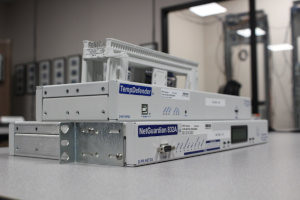
Whether you're new to our equipment or you've used it for years, DPS factory training is the best way to get more from your monitoring.
Reserve Your Seat Today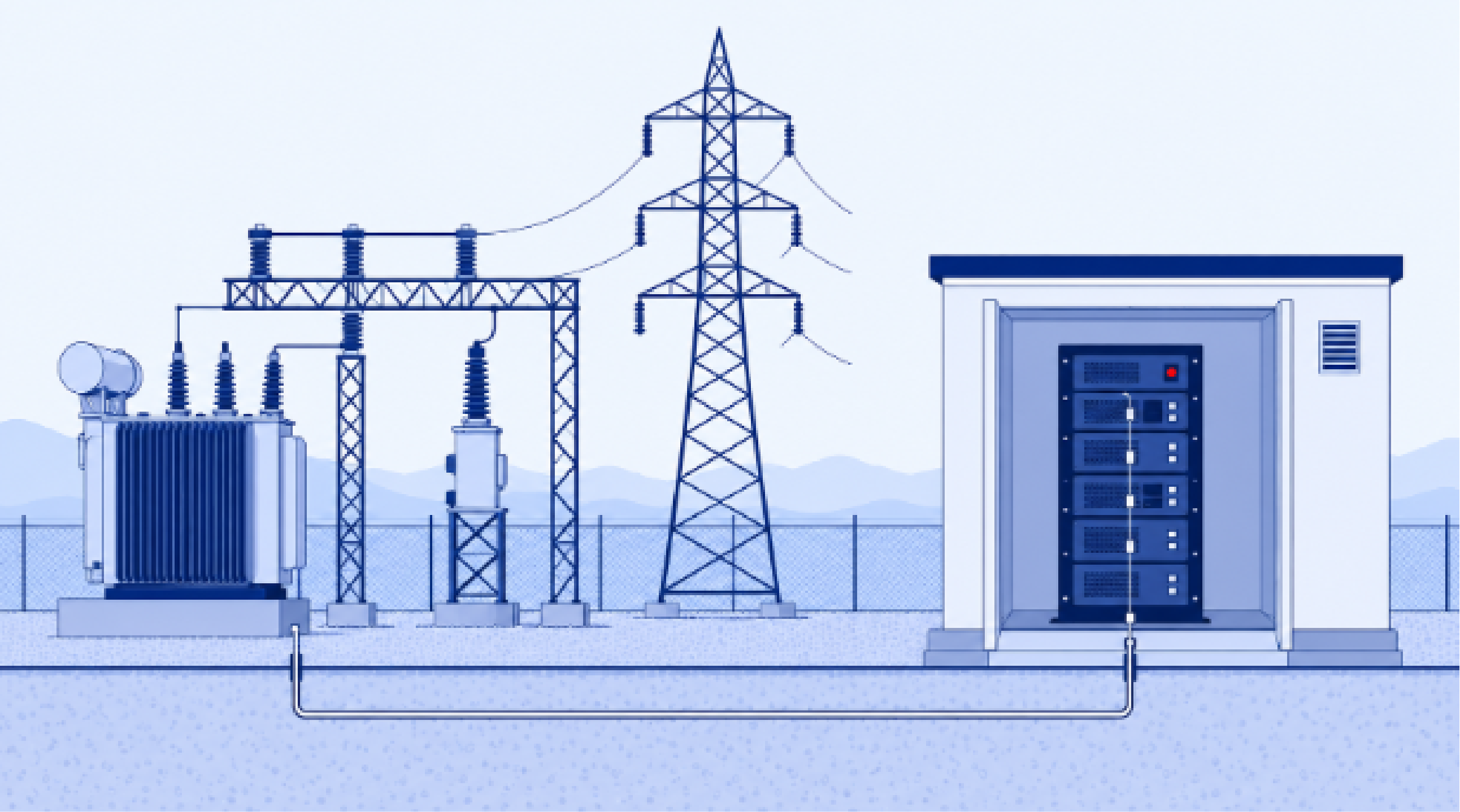
If you run monitoring for a fleet of substations, transmission sites, and communications huts, you've probably looked at the Schweitzer Engineering Laboratories (SEL) Real-Time Automation Controller (RTAC) and wondered whether a DPS remote monitoring solution does the same job, a different job, or a better one for what you actually need. On the surface, both sit at the edge of your network, both do protocol conversion, and both report data back to a central operations point.
The SEL RTAC and a DPS NetGuardian-plus-T/Mon system are built for overlapping but different primary jobs, so the right choice depends on what you're trying to accomplish. In a lot of mature utilities, the two run side by side.
We've built remote monitoring equipment in Fresno, California since 1986, and 15 of the top 21 US power utilities have run DPS gear. Everything below about the SEL RTAC comes from SEL's own published information.
DPS is a strong fit when your priority is monitoring power, environment, security, and equipment health across a lot of substations and communications sites from one place. That's where our strengths line up:
If that's the job in front of you, DPS is worth a spot on your shortlist.
One platform runs control logic on the power system. The other watches the infrastructure that keeps the site running.
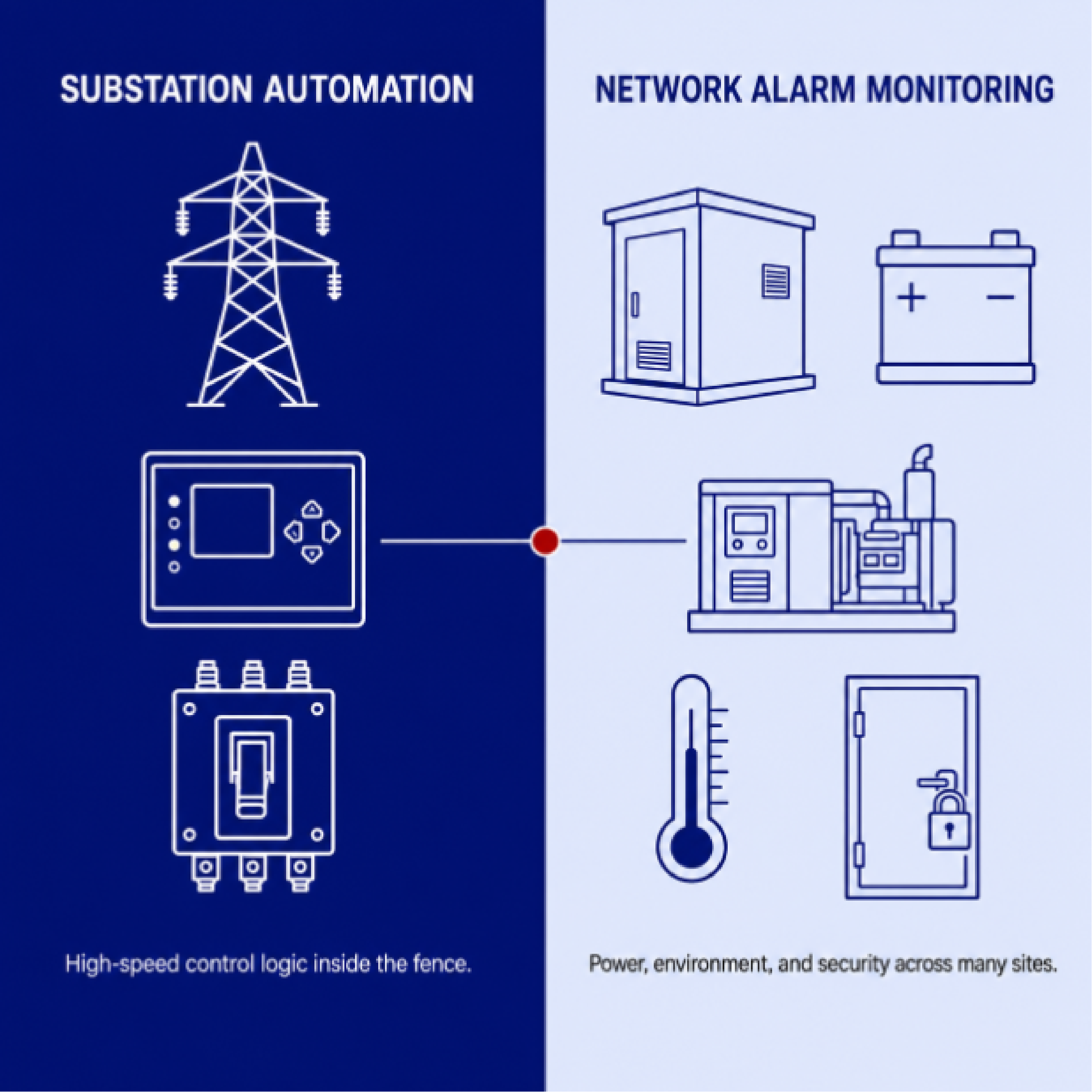
A substation automation controller is the local brain of the power system inside the fence. It talks to protective relays, meters, and other intelligent electronic devices, runs high-speed control logic, and makes sub-second decisions like tripping a breaker or synchronizing generation. The SEL RTAC lives in this category.
A network alarm monitoring system watches the physical and telecom infrastructure that keeps everything else running. It pulls together battery plant voltage, generator fuel level, heating, ventilation, and air conditioning (HVAC) status, door and intrusion sensors, and the health of communications gear across many sites, then reports it all to one screen. Our NetGuardian remote terminal units (RTUs) and T/Mon master station live in this category.
Both read analog values and discrete contacts, and both give operators remote visibility. Where they diverge is what they do with that data. One runs power automation logic; the other consolidates alarms from across a wide territory into one clear operational picture. If you want a deeper walk-through of the buying decision, our substation monitoring system buying guide covers it in detail.
The DPS setup is a set of NetGuardian RTUs at each site, all reporting to a T/Mon LNX master station at your operations center. Together they give your team a single, live view of every site at once: the state of power, environment, security, and equipment health, all in one place.
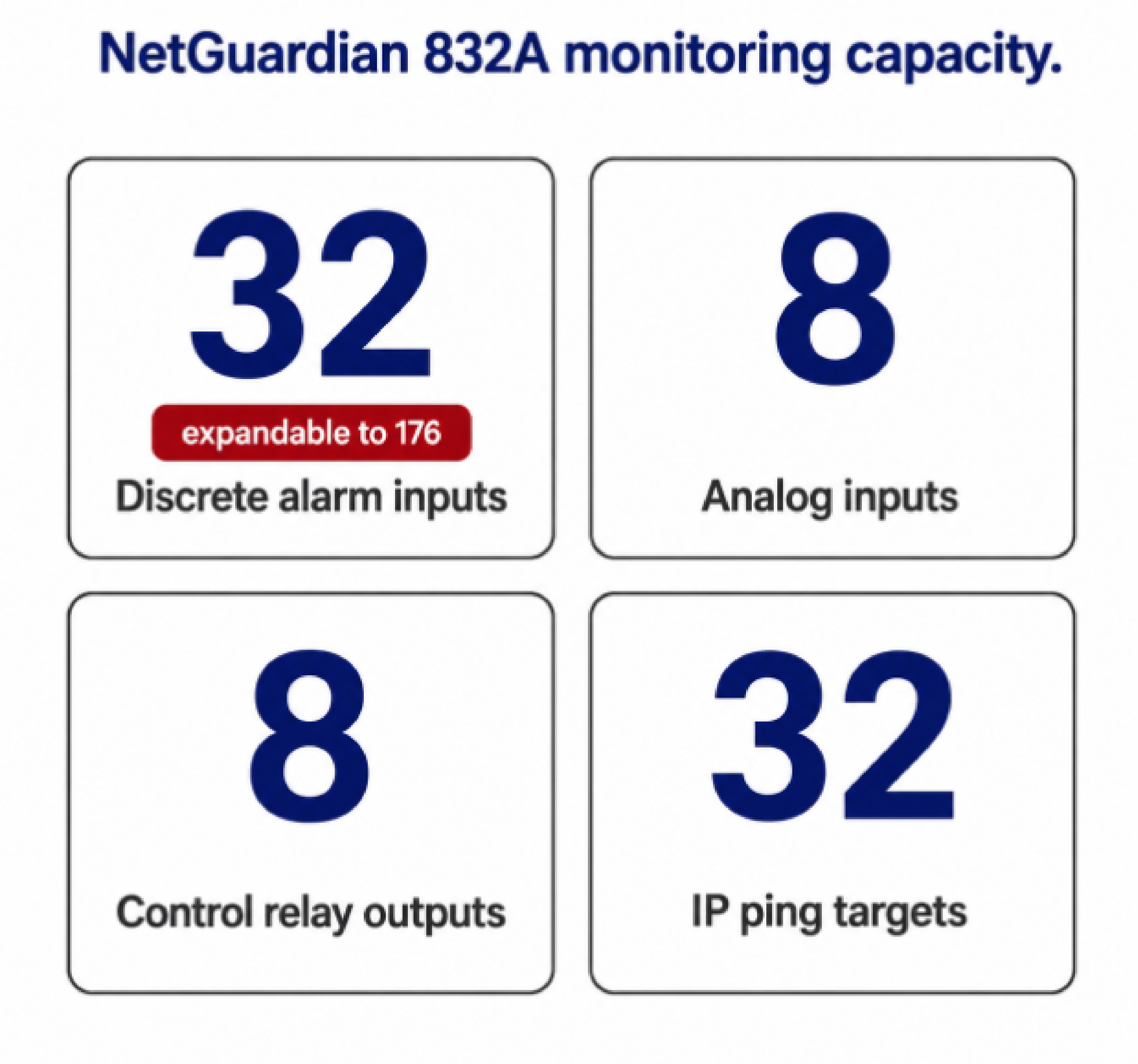
A NetGuardian 832A handles 32 discrete alarm inputs (expandable to 176 with expansion units), 8 analog inputs, and 8 control relay outputs, so it can watch battery voltage, generator fuel, temperature, humidity, and door sensors while also giving you remote control. It pings up to 32 Internet Protocol (IP) targets to confirm local switches and routers are still alive, and its serial reach-through ports let a technician log into gear at the site over the local area network (LAN) without a separate terminal server. It runs on dual -48 VDC power with dual Ethernet.
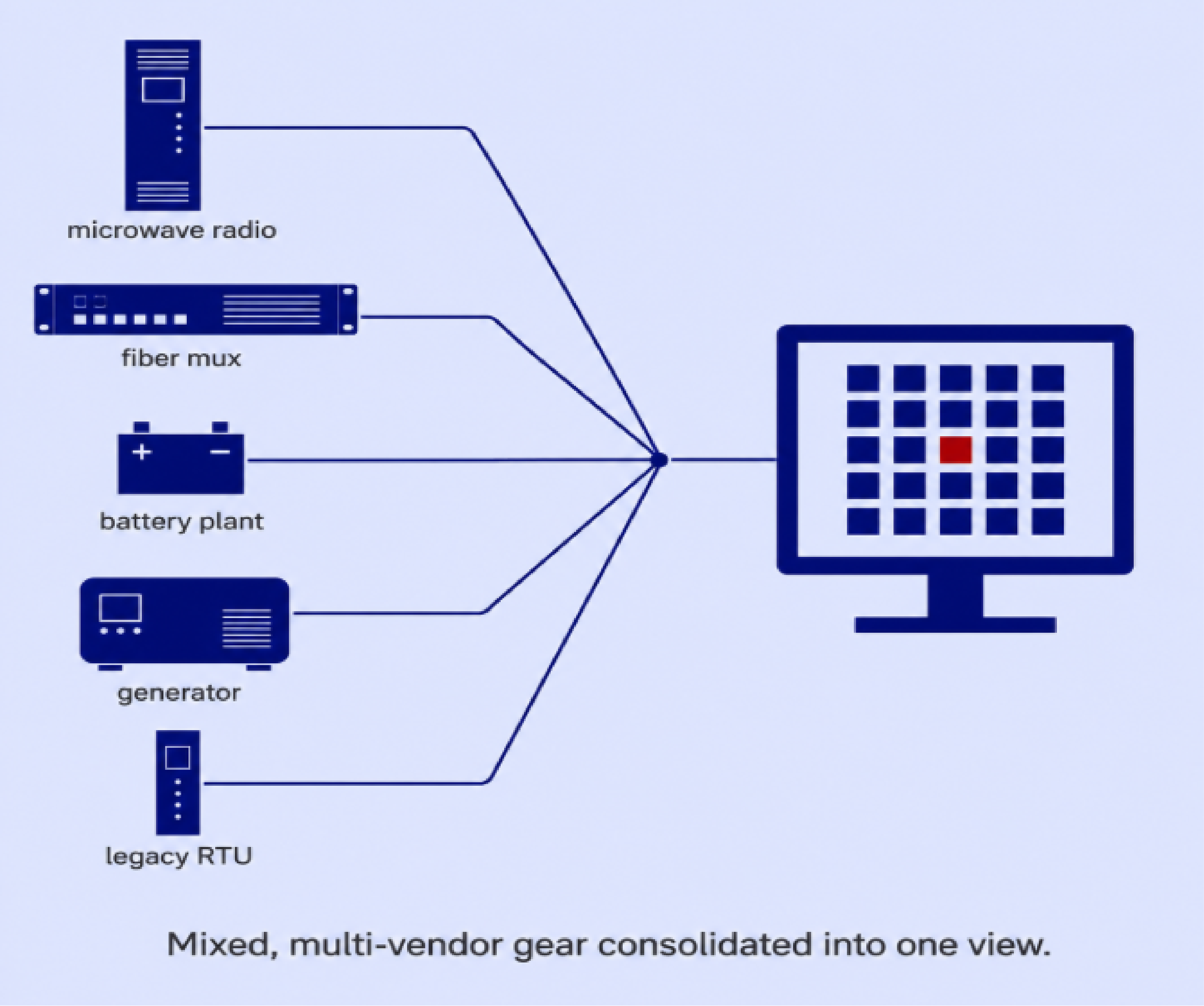
T/Mon is where the wide-area view comes together. A single T/Mon LNX scales to thousands of devices and hundreds of thousands of alarm points, and it speaks more than 30 protocols, including Simple Network Management Protocol (SNMP) v1, v2c, and v3, Distributed Network Protocol 3 (DNP3), Modbus, Transaction Language 1 (TL1), and a long list of proprietary and older protocols that many utility networks still depend on. Its text-parsing engine can read raw diagnostic output from proprietary gear and turn it into a clean, actionable alarm. Electric utilities like NV Energy and Pepco use T/Mon to bring alarms from mixed equipment into one platform, and Orlando Utilities Commission uses it across its electric and water network.
SEL describes the RTAC as a real-time automation controller for substation control, monitoring, and protocol conversion. Its defining feature is an embedded International Electrotechnical Commission (IEC) 61131-3 logic engine, configured with SEL's acSELerator RTAC software using programming languages like Ladder Diagram, Structured Text, and Continuous Function Chart. That lets protection engineers program time-critical automation directly into the controller.
On protocols, SEL's published materials list broad support for utility and automation standards, including DNP3, Modbus, IEC 60870-5-101/104, the IEC 61850 suite with Generic Object Oriented Substation Event (GOOSE) and Manufacturing Message Specification (MMS) messaging, and Institute of Electrical and Electronics Engineers (IEEE) C37.118 synchrophasors, along with SEL's own Mirrored Bits communications. The product line runs from the compact, DIN-rail SEL-3505 up to rack-mount models like the SEL-3350 and SEL-3555. SEL also publishes IEEE 1613 compliance for substation hardening and a ten-year hardware warranty.
That's a capable automation platform. If your project centers on protection logic, IEC 61850, or synchrophasors, it's the kind of tool built for that work.
| Factor | SEL RTAC (per SEL's published information) | DPS Telecom (NetGuardian + T/Mon) |
|---|---|---|
| Primary purpose | Substation automation and data concentration: deterministic control logic, protocol gateway | Network alarm and remote-site monitoring: power, environment, security, and equipment health across many sites |
| Configuration model | Script and logic-based automation via an IEC 61131-3 logic engine and acSELerator software | Menu-driven web interface, no automation programming |
| Protocol support | DNP3, Modbus, IEC 60870-5-101/104, IEC 61850 (GOOSE and MMS), IEEE C37.118 synchrophasors, Mirrored Bits | 30+ protocols including SNMP v1/v2c/v3, DNP3, Modbus, TL1, and other proprietary and older protocols; T/Mon mediates multi-vendor gear to standard protocols |
| Form factor | Compact DIN-rail (SEL-3505) up to rack-mount (SEL-3350, SEL-3555) | 19-inch and 23-inch rack-mount NetGuardian RTUs; T/Mon LNX master station |
| Environmental / hardening standard | IEEE 1613 substation hardening | Network Equipment-Building System (NEBS) Level 3, tested in-house at our Fresno lab, official certification available on request |
| Support model | SEL support | Single-vendor RTU plus master from one US manufacturer, with direct access to the engineers who design the gear and lifetime product support |
| Lifecycle | Ten-year hardware warranty | 20+ year field life, with backward compatibility for older and proprietary gear |
| Evaluation / guarantee | Per SEL | 30-day loaner program (you pay shipping), money-back guarantee, and trade-in credit toward upgrades |
The above data was gathered by reviewing published SEL product information. It may not capture the full breadth of available models, and some data may have changed since it was reviewed.
The two platforms are configured in different ways because they were built for different work. The SEL RTAC is programmed with an IEC 61131-3 logic engine in acSELerator software, which is what lets it run custom automation schemes. That programmability is the point of an automation controller.
Our NetGuardian and T/Mon are configured through a menu-driven web interface. You set thresholds from drop-down menus, for example a minor alarm when a battery string drops below 48 VDC and a critical alarm below 42 VDC, and you provision IP ping targets the same way. There's no automation programming because the job is standardized monitoring across many sites rather than site-specific control logic. For a utility telecom group standing up monitoring at 200 repeater sites, that menu-driven model keeps deployment consistent from site to site. Our guide on how to choose the best RTU for utility substation monitoring walks through matching the configuration model to your team and your use case.
Both platforms are hardened, under two different frameworks aimed at two different environments. SEL publishes IEEE 1613 compliance, the standard for communications equipment inside a high-voltage substation, where electromagnetic interference and switching surges are the main threats.
DPS gear is built and tested to NEBS Level 3, the telecom standard for physical survivability against temperature extremes, vibration, seismic events, and corrosive atmospheres at remote sites and communications huts. We run that NEBS testing in-house at our Fresno lab at no added cost to you, using our own anechoic chamber, vibration tables, and thermal testing, and official NEBS certification is available on request. Neither standard is a knock on the other. Each matches the place the equipment is meant to live: IEEE 1613 for the switchyard, NEBS for the telecom side of the site.
For North American utilities, the North American Electric Reliability Corporation (NERC) Critical Infrastructure Protection (CIP) standards are the enforceable framework for protecting the bulk electric system. The two platforms line up with different parts of it.
SEL's published security features for the RTAC address the electronic side, with an allowlist security model it calls exe-GUARD, role-based accounts, encrypted protocols like Secure Shell (SSH) and Transport Layer Security (TLS), Lightweight Directory Access Protocol (LDAP) authentication, and Syslog reporting. Those features help harden the electronic security perimeter around relay access.
Our equipment lines up with the physical-security side. A NetGuardian at a remote substation can manage access codes, watch door sensors, and feed a building access system, and T/Mon can correlate a door opening at a site with what else is happening on the network. That supports the physical access logging that CIP-006 and CIP-014 call for.
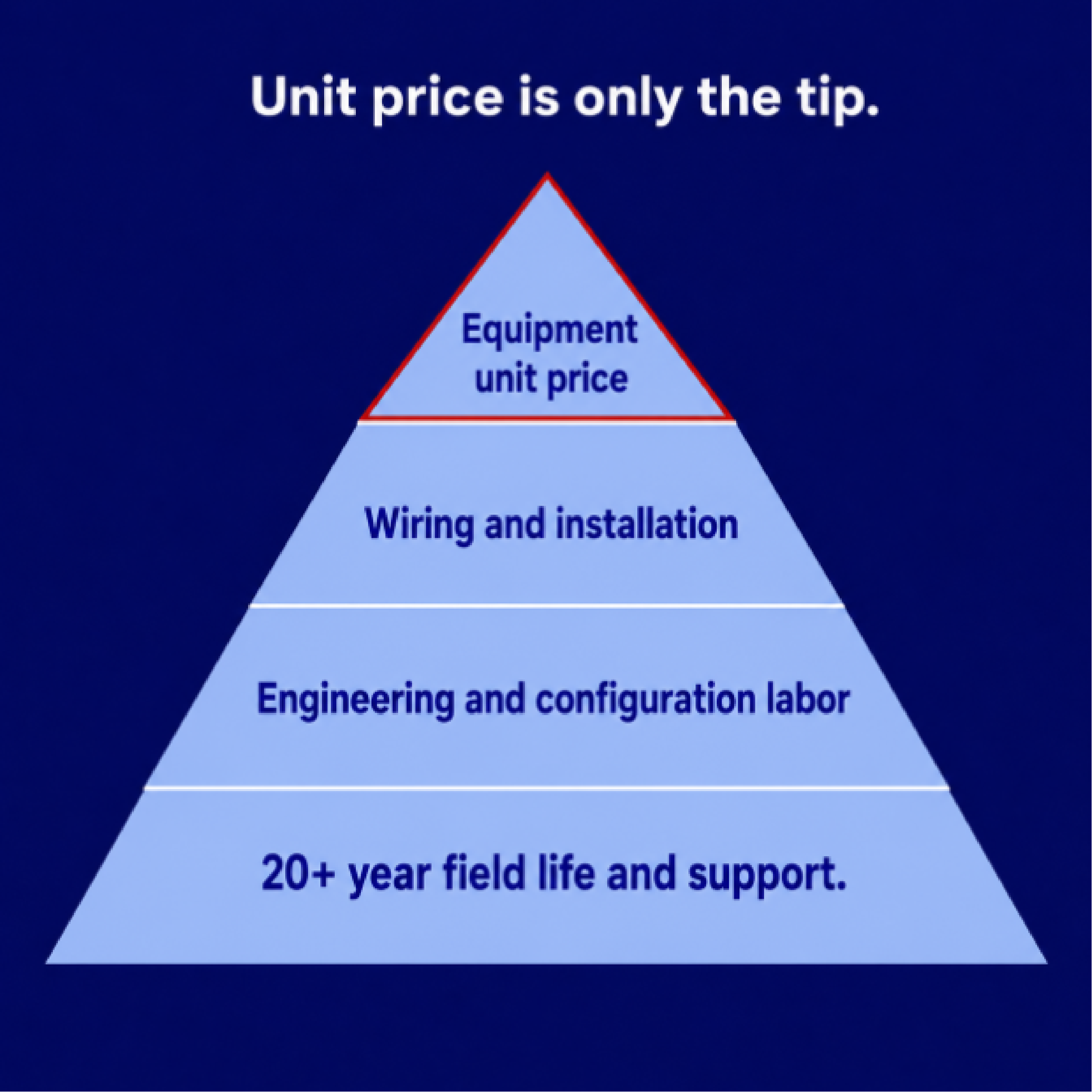
Upfront unit price is only part of the picture in utility procurement. Our RTU pricing guide breaks the range down by capacity, from roughly $500 for entry-level units at small distribution sites up to $5,000 or more for high input/output (I/O) units at transmission sites, and the fully loaded cost of an installation runs much higher per site once you add wiring, engineering labor, and system configuration. That's why we focus on total cost of ownership.
We don't charge non-recurring engineering (NRE) fees for custom work on reasonable order quantities. So if you need a chassis sized to fit an existing cabinet, or a software module for a protocol you already run, we engineer it without a separate design charge. We build for a 20-plus year field life and keep backward compatibility with older and proprietary gear, which means you can bring existing field equipment into a modern T/Mon without a rip-and-replace upgrade. SEL, for its part, publishes a ten-year hardware warranty on the RTAC.
DPS CEO and co-founder Bob Berry makes the same point about price versus value in his book 100% Uptime:
"I'm always amazed when I watch executives spend $100,000, $200,000, or more on infrastructure equipment, and then bristle at spending even $800 on protecting that valuable gear."
If you want the broader rundown of how we approach value versus price, we lay it out in why buy from DPS.
Framing this as an either/or is usually a mistake, because in a mature substation the two do different jobs and can run in the same facility.
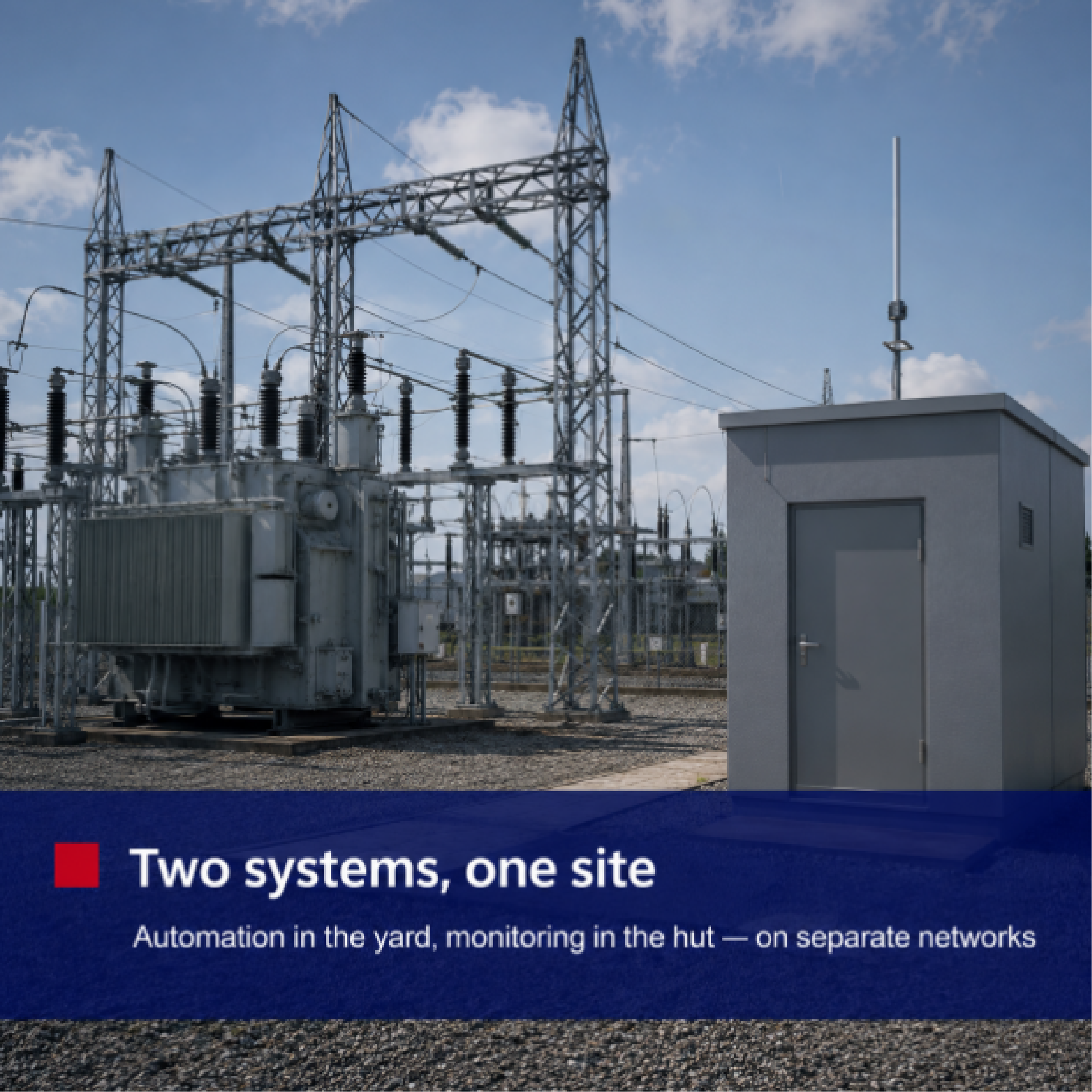
Inside the switchyard, the SEL RTAC can sit on the IEC 61850 bus, handle GOOSE messaging and synchrophasors, run protection logic, and map power data up to Supervisory Control and Data Acquisition (SCADA) over DNP3. In the telecom hut next door, a NetGuardian can watch the battery plant, generator, temperature, and building access, reach through to the fiber multiplexer and microwave radio over serial, and report all of it to your telecom group's T/Mon.
Because our RTUs report to third-party SNMP managers and T/Mon mediates multi-vendor gear to standard protocols, our equipment can monitor alongside an RTAC installation without touching the protection network. That separation keeps power automation data flowing to the grid operators and infrastructure health flowing to the network maintenance team, which also keeps alarm noise out of the primary SCADA room.
There are jobs where an automation controller like the SEL RTAC is the right tool and a monitoring RTU isn't a substitute:
If that's your project, the RTAC is built for it. Our gear is built to monitor the physical and telecom infrastructure around it.
Yes. Our NetGuardian RTUs report to third-party SNMP managers, and T/Mon mediates multi-vendor gear, so DPS monitoring can run alongside an RTAC. Our equipment handles site power, environment, and security while the RTAC handles substation automation.
The RTAC reads analog and discrete inputs, so it can take in some environmental and power values as part of its data-concentration role. Its published purpose is substation automation and protocol conversion, while our NetGuardian and T/Mon are purpose-built to consolidate power, environment, security, and equipment health across many sites.
A substation automation controller runs high-speed control logic on power system data and can make automated decisions like breaker operations. A monitoring RTU collects alarms and telemetry, such as battery voltage, door status, and equipment health, and reports them to a central master for situational awareness.
Yes. Our RTUs and T/Mon support DNP3, Modbus, SNMP, and more than 30 protocols in total. The DNP Users Group maintains the DNP3 standard, and our comparison of DNP3 vs Modbus explains when each one fits.
If you're weighing remote monitoring for your substations and communications sites, we're happy to help you figure out what fits, whether that runs alongside an SEL RTAC or stands on its own. Tell us what you're trying to accomplish and we'll design around it, and you can try the equipment in your own environment with our 30-day loaner program.
Talk to an Engineer | 800-693-0351

Andrew Erickson
Andrew Erickson is an Application Engineer at DPS Telecom, a manufacturer of semi-custom remote alarm monitoring systems based in Fresno, California. Andrew brings more than 19 years of experience building site monitoring solutions, developing intuitive user interfaces and documentation, and opt...