Check out our White Paper Series!
A complete library of helpful advice and survival guides for every aspect of system monitoring and control.
1-800-693-0351
Have a specific question? Ask our team of expert engineers and get a specific answer!
Sign up for the next DPS Factory Training!
Whether you're new to our equipment or you've used it for years, DPS factory training is the best way to get more from your monitoring.
Reserve Your Seat TodayWhen fire, EMS, or police need to reach dispatch and the microwave link is down, the radio at that site goes dark. There's no time to troubleshoot blindly. Public safety communications networks require the same level of monitoring as the emergencies they support: continuous, reliable, and immediate.
At DPS Telecom, we've worked with county emergency services, 911 dispatch centers, law enforcement agencies, and public safety networks across the country. Our remote monitoring systems are built to give you 7x24 visibility into every tower site, dispatch center, and critical communications link you operate.
Talk to a Monitoring Specialist | 800-693-0351
Emergency communications infrastructure spans multiple layers, each one a potential failure point. The monitoring gaps that matter most in this environment include:
| Asset | What to Monitor |
|---|---|
| Radio tower sites | Forward power, reflected power, generator voltage, microwave signal fade |
| 911 dispatch centers | Environmental conditions, power systems, door access |
| Microwave backhaul links | Signal degradation, link failures |
| Remote repeater sites | Equipment alarms, temperature, site access |
| Generators and batteries | Voltage levels, fuel levels, rectifier status |
"We are monitoring nine tower sites, plus our 911 center. We are getting analog inputs for generator voltage, and microwave signal fade. Discrete alarms might be door entry, or temperature high/low, things like that."
- Fred Marvin, Steuben County Office of Emergency Services
Radio network failures in a 911 environment don't just cost money. They can directly affect response to life-safety incidents.
As Fred Marvin of Steuben County Office of Emergency Services put it: "Because we operate in a 911 environment, it is better to know early rather than later if something happens. If they're trying to dispatch Fire, EMS, or public safety to an event - and the microwave is down - it means the radios at that site can't be operated either."
The only way to know early is to have monitoring systems actively watching every site, all the time.
Talk to a Monitoring Specialist | 800-693-0351
A Remote Telemetry Unit (RTU) at each tower site or dispatch center is the foundation of any monitoring system. RTUs collect discrete alarms from equipment and sensors, monitor analog voltages for power and radio signal levels, and report all of that data back to a central system.
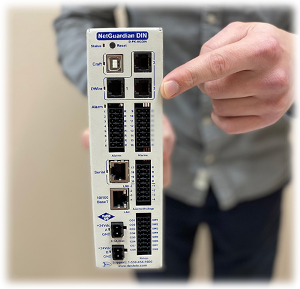
DPS Telecom's NetGuardian RTU family is purpose-built for this type of deployment. Each unit monitors:
For most emergency communications sites, a single NetGuardian handles all alarm collection at that location.
Once your deployment grows beyond a handful of sites, logging into each RTU individually becomes unmanageable. A central alarm master aggregates all data from your remote sites into one interface, so your team can see the full network at a glance.
Our T/Mon alarm master supports 35+ protocols, which means it can consolidate alarms from equipment of different ages and manufacturers under one system. For emergency communications networks that have added equipment across different procurement cycles, this multi-protocol capability matters.
Talk to a Monitoring Specialist | 800-693-0351
Standard email or text alerts work well for most environments. For agencies where staff carry handheld radios on duty, we've developed RTUs that use a push-to-talk (PTT) relay to broadcast pre-recorded alert messages directly over the radio channel when critical alarms occur.
This eliminates dialing delays and allows an entire shift to be notified simultaneously, on the same radios they already carry. It was developed specifically for public safety clients who needed faster, more attention-grabbing alarm delivery for their most critical alarm conditions.
Monitoring systems that only tell you something is wrong are only half the solution. Your alerts should also tell your team what to do. If a tower light fails, the notification should include a reminder to contact the FAA. If a fuel level drops, it should include the refueling contractor's number.
This kind of embedded response guidance is especially important for newer technicians. DPS monitoring systems are configured to include these details directly in the alarm notification, so your institutional knowledge is in the system rather than locked in the heads of your most senior staff.
| Organization | Application | Solution |
|---|---|---|
| Steuben County Office of Emergency Services | 911 radio network: 9 tower sites + dispatch center | NetGuardian RTUs monitoring generator voltage, microwave signal, door entry, temperature |
| Lancaster County | 911 dispatch center monitoring | NetGuardian + T/Mon |
| Kitsap County CENCOM | Public safety radio network monitoring | NetGuardian 832A |
| West Coast Law Enforcement Agency | Preventing network downtime | Remote network alarm monitoring |
Talk to a Monitoring Specialist | 800-693-0351
What does emergency communications monitoring cover?
Emergency communications monitoring covers the remote infrastructure that supports first responder radio networks, 911 dispatch centers, and public safety microwave backhaul links. This typically includes generator and battery monitoring, radio signal levels, environmental conditions, and site access alarms at tower and repeater sites.
How do RTUs send alarm notifications in a public safety environment?
RTUs can send email and text alerts to on-call staff. For agencies where personnel carry handheld radios, DPS has also built RTUs that use a push-to-talk relay to broadcast pre-recorded alert messages over the radio channel, notifying the entire shift simultaneously without dialing delays.
Can your monitoring system work with legacy emergency communications equipment?
Yes. Our T/Mon master station supports 35+ protocols, including legacy and proprietary formats. This allows agencies to bring older equipment under the same monitoring umbrella as newer gear, without replacing it.
How many sites does a monitoring system need to cover?
For networks under about 10 sites, individual RTUs with their own web interfaces may be sufficient. Larger networks typically benefit from a central alarm master station that aggregates all site data into one view.
What government or public safety clients does DPS Telecom work with?
DPS Telecom has worked with county emergency services offices, 911 dispatch centers, law enforcement agencies, and transit authorities, including Steuben County Office of Emergency Services, Lancaster County 911, Kitsap County CENCOM, and New York City Transit. See our government remote monitoring page for more.
Talk to DPS Telecom About Your Network
DPS Telecom has been building remote monitoring systems since 1986. We've manufactured more than 172,800 devices for over 1,500 organizations, including public safety agencies and emergency communications networks across the country.
Our application engineers will assess your sites, protocol requirements, and notification needs before recommending a configuration. There's no obligation, and we offer a 30-day loaner program so you can evaluate our equipment in your own environment before committing.