Check out our White Paper Series!
A complete library of helpful advice and survival guides for every aspect of system monitoring and control.
1-800-693-0351
Have a specific question? Ask our team of expert engineers and get a specific answer!
Sign up for the next DPS Factory Training!
Whether you're new to our equipment or you've used it for years, DPS factory training is the best way to get more from your monitoring.
Reserve Your Seat Today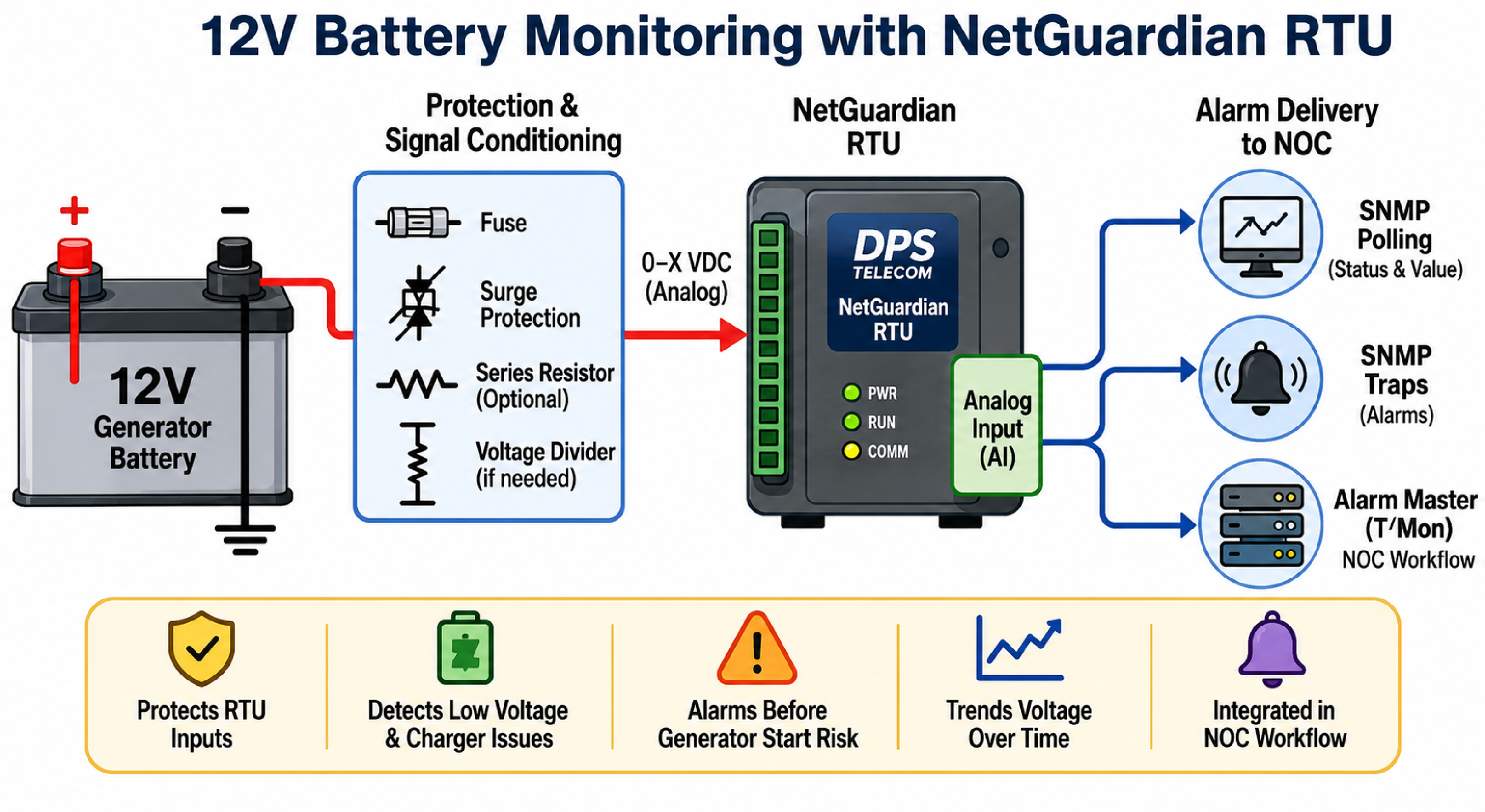
When monitoring infrastructure remotely, 12V battery monitoring involves measuring battery voltage (and sometimes charge and temperature) so operations teams can detect early signs of generator start-risk, charger failure, or battery aging before an outage occurs.
A common scenario is a remote or unattended site that already monitors environment (like server room temperature) but does not alarm on the generator starting system, where a simple low-voltage condition can prevent the generator from cranking when commercial power fails.
This article explains how 12V battery voltage can be monitored using the analog inputs on DPS Telecom NetGuardian RTU platforms (including NetGuardian LT G2), what protection or signal conditioning is typically required, and how to turn a voltage reading into actionable alarms in a NOC workflow.
In generator-backed sites, 12V generator battery monitoring means continuously measuring the DC battery that powers the starter motor and control electronics, then alarming when voltage falls outside healthy operating bands.
A generator battery can fail quietly because the site remains online during normal conditions, and routine visits may be infrequent.
A voltage trend can also reveal charging system issues, such as a failed charger, a blown fuse, sulfation, or parasitic loads that slowly discharge the battery.
Battery voltage monitoring is defined as a health indicator, not a full functional test of cranking capability.
A battery can show acceptable float voltage yet still fail under high cranking load, especially if internal resistance is high.
Many teams start with voltage because it is easy to deploy with existing analog monitoring, and then expand to additional sensors or maintenance procedures if needed.
Direct wiring is defined as connecting the battery terminals (through appropriate protection) to an RTU analog input so the RTU measures the battery voltage without an external transducer.
Whether direct wiring is appropriate depends on the specific NetGuardian model, the analog input electrical range, and the site grounding and surge environment.
DPS Telecom commonly advises customers to verify these details in the product documentation for the exact hardware revision, because analog input ranges and protection characteristics can vary by model and configuration.
A 12V lead-acid system is defined by nominal voltage, not the full operating range.
Depending on charger mode and temperature compensation, the battery may be around 12.0V to 12.8V at rest, and higher while charging.
Transient events can create brief spikes and dips, especially around engine cranking and charger switching, so the measurement approach should include basic protection and filtering practices.
Signal conditioning is defined as any circuit or device placed between the battery and the RTU analog input to keep the measurement within safe limits and to reduce noise or ground problems.
Even when direct measurement is electrically possible, protection components are often used to reduce risk to the RTU and improve measurement stability.
An intermediary is defined as a purpose-built transducer, isolation amplifier, DC-DC converter, or battery monitoring module that outputs a known-safe analog signal.
An intermediary is commonly recommended when any of these conditions apply:
Good wiring practice is defined as routing and terminating conductors to reduce noise pickup, avoid ground loops, and maintain predictable reference points.
An alarm threshold is defined as a configured voltage boundary that triggers an alert when the measured value crosses the boundary for a defined duration.
Battery alarming should be configured to reduce nuisance notifications while still catching slow degradation and sudden failures.
Exact setpoints should be defined by the battery chemistry, charger specification, temperature compensation, and the site maintenance policy.
Alarm hysteresis and delay are defined as configuration options that require a sustained condition before alarming and that prevent rapid toggling around a threshold.
The measurement point is defined as the physical location where the voltage is sampled, such as at the battery terminals or at a distribution panel.
Measuring at the battery terminals gives the most direct view of battery condition, while measuring farther downstream can include voltage drop across fuses and wiring.
Consistency is important because the alarm thresholds should match the selected measurement point.
NOC alarm workflow integration is defined as turning a sensor reading into an event that is routed, escalated, and acknowledged through the same tools used for other critical alarms.
Battery alarms are most effective when they are treated like other site-critical conditions rather than a passive graph.
An RTU is defined as a remote terminal unit that collects physical inputs (analog, discrete, serial) and presents them to monitoring systems in a standard form.
DPS Telecom NetGuardian RTUs are commonly used to bring analog battery measurements and related site alarms into IP-based monitoring.
An alarm master is defined as a central platform that correlates, displays, and routes alarms from many sites and many protocols.
DPS Telecom T/Mon alarm master products are commonly used in NOC environments to unify alarm presentation and escalation across a mixed vendor network.
Protocol mediation is defined as translating between alarm formats so teams do not need separate monitoring stacks for each device type.
DPS Telecom commonly supports protocol mediation and alarm integration approaches that consolidate battery alarms with environmental, power, and network events.
Installation mistakes are defined as wiring, grounding, or configuration errors that cause the measured value to be wrong or that expose equipment to avoidable electrical stress.
A decision table is defined as a structured comparison that helps teams select an approach based on constraints and risk.
| Decision Factor | Direct To RTU Analog Input (With Basic Protection) | Intermediary (Divider, Isolation, Transducer, Or Module) |
|---|---|---|
| Analog input range compatibility | Appropriate only when verified compatible with max battery/charger voltage | Recommended when range is uncertain or clearly incompatible |
| Electrical noise and transients | Works in low-noise environments; may need added suppression | Better when cranking, switching, or lightning exposure is a concern |
| Grounding differences | Risk of unstable readings if grounds differ | Isolation can prevent ground loop issues |
| Implementation complexity | Lower complexity once range and wiring are confirmed | Higher complexity but can standardize output and protection |
| Risk to RTU input | Higher if protection is minimal or assumptions are wrong | Lower when designed for fault/surge containment |
An implementation checklist is defined as a step-by-step set of actions to reduce missed requirements and rework.
Direct monitoring is possible only if the specific analog input range and reference requirements support the full expected battery and charger voltage.
Verification against the exact product documentation is required before wiring.
An intermediary is recommended when the electrical environment is noisy, the analog input range is uncertain, or grounding differences could cause unstable readings.
Even with direct wiring, basic protection like fusing and surge suppression is a common best practice.
Measuring at the battery terminals is usually the most direct indicator of battery condition.
Measuring on a downstream bus can be useful for catching wiring and fuse problems, but thresholds must match that measurement location.
Voltage monitoring indicates charging state and abnormal conditions, but it does not replace a load test or starter performance test.
Many organizations combine voltage alarming with periodic maintenance tests.
Use alarm delay and hysteresis so brief transients do not generate alerts.
Thresholds should be aligned with the charger profile and expected float voltage range.
Battery alarms can be forwarded using SNMP polling and, where configured, SNMP traps, and then consolidated in an alarm master.
DPS Telecom T/Mon alarm master products are commonly used to unify battery, environmental, and network alarms into a single NOC workflow.
If a generator start battery failure created an avoidable outage risk, the next step is to standardize how the battery is measured, protected, alarmed, and routed to operators.
DPS Telecom can help validate analog input strategy, recommend appropriate NetGuardian RTU monitoring architecture, and integrate battery alarms into your existing NOC workflow.

Andrew Erickson
Andrew Erickson is an Application Engineer at DPS Telecom, a manufacturer of semi-custom remote alarm monitoring systems based in Fresno, California. Andrew brings more than 19 years of experience building site monitoring solutions, developing intuitive user interfaces and documentation, and opt...