Check out our White Paper Series!
A complete library of helpful advice and survival guides for every aspect of system monitoring and control.
1-800-693-0351
Have a specific question? Ask our team of expert engineers and get a specific answer!
Sign up for the next DPS Factory Training!
Whether you're new to our equipment or you've used it for years, DPS factory training is the best way to get more from your monitoring.
Reserve Your Seat TodayA UPS system is only as reliable as your ability to know when something goes wrong with it. If your uninterruptible power supply fails silently at a remote site, you won't find out until equipment goes down. A remote UPS monitoring system solves that by sending alerts the moment a problem occurs, before a small power issue becomes a full site outage.
At DPS Telecom, we've helped over 1,500 organizations monitor UPS systems alongside the rest of their remote site infrastructure, with more than 172,000 devices deployed across telecom, utilities, transportation, and government networks.
Talk to an Engineer | 800-693-0351
A UPS monitoring system connects to your uninterruptible power supply and reports its status to a central location. Depending on how the UPS communicates, this may happen via SNMP traps, contact closure alarms, analog voltage readings, or Modbus registers.
The monitoring system watches for conditions like:
When any of these conditions occur, the system sends an alert to the right staff member by email, text message, or through a central alarm management platform.
UPS problems rarely happen independently. Commercial power failures, generator start failures, HVAC problems, and extreme temperatures all affect backup power performance. Monitoring your UPS in isolation leaves you without the context to respond effectively.
At DPS Telecom, we recommend monitoring UPS systems as part of a complete site approach that includes:
When a UPS alarm fires, you want to already know whether commercial power is down, whether the generator started, and whether temperature is within range. That context determines who you send, what they bring, and how urgent the dispatch is. Central Utah Telephone learned this firsthand when low voltage went undetected across their network before a comprehensive monitoring system was in place.
Talk to an Engineer | 800-693-0351
The most common approach to remote UPS monitoring uses a Remote Telemetry Unit (RTU) installed at each site. The RTU collects data from the UPS and transmits it back to a central system or directly to your staff.
Most modern UPS units communicate via SNMP. An RTU can poll the UPS for status data or receive SNMP traps when alarms occur. Older UPS systems may output contact closure alarms (a dry contact that changes state when the unit goes on battery or detects a fault). RTUs handle both.
For UPS units that communicate via Modbus, an RTU can read battery voltage, load percentage, and runtime remaining directly from Modbus registers. Our article on battery monitoring best practices covers how to set meaningful thresholds for these analog readings.
Once the RTU detects a UPS alarm, it can:
For smaller networks (fewer than about 10 sites), the RTU's built-in web interface and email/text alerting may be all you need. For larger networks, a central alarm master like the DPS T/Mon LNX consolidates alarms from all sites into a single view with geographic map display, escalation procedures, and multi-user access.
| Signal Type | What It Tells You | How RTU Collects It |
|---|---|---|
| UPS on battery | Commercial power has failed | Contact closure or SNMP trap |
| Battery voltage | Battery health and charge level | Analog input or Modbus register |
| Low battery warning | Battery will run out soon | Contact closure or SNMP trap |
| UPS bypass mode | UPS is not protecting the load | Contact closure or SNMP trap |
| Output overload | Load exceeds UPS capacity | SNMP trap or Modbus |
| Internal temperature high | Thermal fault in UPS | SNMP trap |
| Battery replace | Battery has exceeded service life | SNMP trap or contact closure |
Talk to an Engineer | 800-693-0351
The right configuration depends on how your UPS communicates and how many sites you manage.
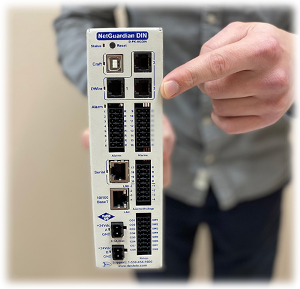
For small deployments (1-10 sites): A NetGuardian RTU at each site can monitor UPS alarms alongside temperature, door access, and other equipment. Staff receive email or text alerts directly from the RTU. No central server required.
For medium to large networks (10+ sites): A central alarm master station collects alarms from all RTUs into a unified interface. The T/Mon LNX supports 35+ protocols, so it can receive data from legacy UPS systems and new ones alike, and from equipment made by different manufacturers. Our guide to choosing an alarm master for multi-site networks covers the key decision points in more depth.
For SNMP-managed environments: All NetGuardian RTUs support SNMP (v1, v2c, and v3), so they integrate directly with your existing SNMP manager. You can continue using SolarWinds, IBM OpenView, or any standard SNMP platform while adding UPS and environmental monitoring through the RTU layer.
Talk to an Engineer | 800-693-0351
One of the most common problems with any monitoring deployment is alarm fatigue. If every alert goes to everyone, people stop paying attention.
UPS on-battery alarms should go to whoever manages power and backup systems. Low-battery warnings should trigger a maintenance response. Overload alarms should go to whoever manages equipment load at that site.
DPS monitoring systems support configurable alarm routing. You can define who receives which alarms, at what severity, and through which channel (email, text, web interface). If an alarm isn't acknowledged within a set time window, the system can escalate to supervisors or additional staff automatically.
For more on alarm management best practices, see our article on NOC Best Practices for Remote Monitoring.
Most modern UPS units support SNMP for network-based monitoring. Older units may use dry contact outputs (contact closure alarms), and some industrial-grade UPS systems support Modbus. DPS RTUs support all three collection methods.
Yes. NetGuardian RTUs support Ethernet, cellular (via external gateway), T1, fiber, serial, and dialup. If your UPS is at a remote site without Ethernet, the RTU can still report alarms over the available transport.
Not always. For fewer than about 10 sites, an RTU at each location can send alerts directly by email or text. For larger networks, a central alarm master provides a unified view of all sites and more sophisticated routing and escalation capabilities.
When you receive a UPS on-battery alarm, you can immediately determine whether it's a commercial power issue affecting the whole site or an isolated UPS fault. That distinction tells you whether to dispatch a crew, contact a power provider, or wait for power to restore. Without monitoring, you send someone to find out.
DPS Telecom has been building remote monitoring equipment since 1986. Our NetGuardian RTUs are configurable to match exactly what you need to collect from your UPS and other site equipment, including custom I/O configurations for non-standard alarm types.
All equipment is designed and manufactured at our facility in Fresno, California. Technical support is handled directly by our engineers. Every purchase includes free lifetime support and training.
We also offer a 30-day loaner program (you pay shipping only) so you can test the equipment at your sites before committing to a full deployment.
For more information on UPS systems that integrate with our monitoring platform, see The Best Rectifier, Generator, and UPS Systems that Integrate with T/Mon.