Check out our White Paper Series!
A complete library of helpful advice and survival guides for every aspect of system monitoring and control.
1-800-693-0351
Have a specific question? Ask our team of expert engineers and get a specific answer!
Sign up for the next DPS Factory Training!
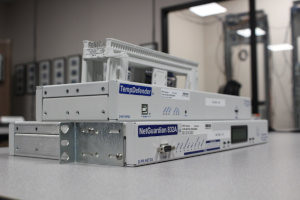
Whether you're new to our equipment or you've used it for years, DPS factory training is the best way to get more from your monitoring.
Reserve Your Seat TodayDPS Telecom delivers 16-alarm voice monitoring in single device
| Field | Details |
|---|---|
| Industry | Rural Telecommunications |
| Company Type | Telephone and internet provider |
| Geography/Coverage | Moundridge, Kansas |
| Primary Challenge | Limited alarm visibility with 4-input voice remote |
| Solution Deployed | NetGuardian Voice 16 with T/Mon SLIM upgrade |
| Key Result | 16 discrete alarms with voice and SNMP reporting |
| Products Used | NetGuardian Voice 16, T/Mon SLIM |
Moundridge Telephone provides telephone and internet services to the people of Moundridge, Kansas. As a rural telecommunications provider, the company relies on continuous network monitoring to maintain service quality and respond quickly to equipment issues at remote sites.
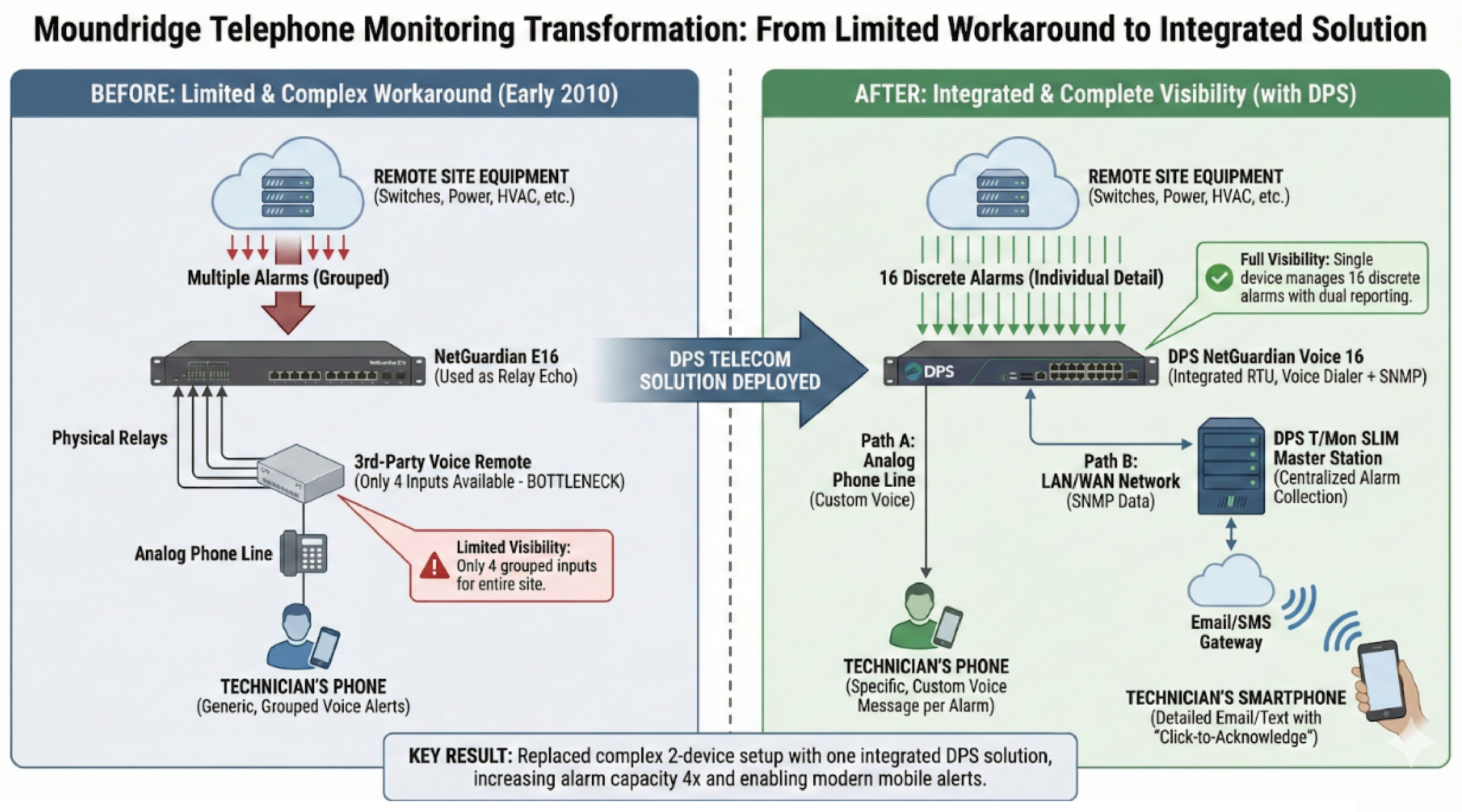
In early 2010, Ken Richards from Moundridge Telephone needed voice alarm notifications for one of his sites. Available solutions were limited to a small voice alarm reporting remote with just 4 alarm inputs. Richards created a workaround using a NetGuardian E16 paired with a separate voice reporting device. The E16 received alarms and echoed them to relays. The relays activated inputs on the voice remote, which sent alerts.
This setup had significant limitations:
Richards wanted greater visibility at his site. He also needed to maintain voice alarm notifications.
After Richards purchased the E16, DPS Telecom developed the NetGuardian Voice 16. The Voice 16 provided 18 controls and 16 discrete alarms with custom voice notification capabilities. It could collect and report all alarms via voice notification and SNMP to Moundridge's master station. When Richards came back to DPS for a better solution, the company swapped his E16 for a Voice 16 free of charge.
DPS configured the Voice 16 with custom voice messages for each alarm type. The system integrated seamlessly with Moundridge's existing network infrastructure. The free equipment swap eliminated upgrade costs.
Assessment
DPS reviewed Richards' existing setup. The team identified the Voice 16 as the right fit for his requirements.
Equipment Swap
DPS exchanged the E16 for a Voice 16 at no charge. This eliminated the cost barrier to upgrading.
Configuration
The Voice 16 was configured for voice notifications. It was also set up for SNMP reporting to the master station.
Master Upgrade
Moundridge upgraded from T/Mon DL to T/Mon SLIM. This enabled enhanced mobile notification capabilities.
The new monitoring system transformed Moundridge Telephone's network visibility and alarm response. The NetGuardian Voice 16 eliminated the separate voice alert remote and provided superior detail in a single device. The T/Mon SLIM upgrade enabled the team to move from pagers to smartphones with click-to-acknowledge email alerts.
Alarm Capacity
Increased from 4 inputs to 16 discrete alarms
Device Count
Reduced from 2 devices to 1 integrated solution
Notification Method
Upgraded from pagers to smartphone email alerts
Response Time
Click-to-acknowledge from any location
"Now that this system is developed, rather than going through the hassle of using the E16, they swapped me out for the V16."
Ken Richards, Moundridge Telephone
Simplified Architecture
Single device replaced the two-unit workaround solution
Enhanced Visibility
4x increase in discrete alarm monitoring capacity
Dual Reporting
Voice notifications plus SNMP to central master
Mobile Accessibility
Email alerts with click-to-acknowledge on smartphones
NetGuardian Voice 16
RTU with 16 discrete alarms and custom voice notifications
T/Mon SLIM
Compact master for SNMP alarm collection and mobile alerts
How do voice alarm notifications work for remote network sites?
Voice alarm systems call designated phone numbers and deliver spoken alarm messages. The NetGuardian Voice 16 provides customizable voice messages. These messages clearly identify which alarm occurred at which site. Technicians can assess severity before dispatching. This saves time and reduces unnecessary truck rolls.
Can monitoring systems send alarms to smartphones instead of pagers?
Yes. Modern alarm masters like the T/Mon SLIM send email notifications directly to smartphones. These emails include alarm details and acknowledgment links. Technicians click to confirm they've received the alarm and are addressing the issue. This ensures accountability and faster response times.
What's the advantage of SNMP for telecom equipment monitoring?
SNMP (Simple Network Management Protocol) is the industry standard for network monitoring. It allows a central master station to collect alarms from all monitored sites simultaneously. The T/Mon SLIM receives SNMP alarms from devices like Metaswitch equipment and NetGuardian RTUs. This provides a complete network view in real time.
How many alarm inputs do rural telephone companies need per site?
Most sites require monitoring for 6-10 conditions. These include door access, temperature, equipment alarms, power status, and backup systems. The NetGuardian Voice 16's 16 discrete alarms accommodate typical site requirements. The extra capacity allows for future expansion without equipment replacement.
Can you upgrade monitoring equipment without replacing everything?
Yes. DPS designs systems for compatibility with existing infrastructure. Moundridge Telephone upgraded their monitoring capabilities while maintaining their network architecture. They kept their existing equipment investments. The NetGuardian Voice 16 integrated with their current setup seamlessly.
If you're managing a telecommunications network with limited visibility or outdated notification methods, we can help design a solution that fits your specific requirements.
Or call us: 1-800-693-0351