Check out our White Paper Series!
A complete library of helpful advice and survival guides for every aspect of system monitoring and control.
1-800-693-0351
Have a specific question? Ask our team of expert engineers and get a specific answer!
Sign up for the next DPS Factory Training!
Whether you're new to our equipment or you've used it for years, DPS factory training is the best way to get more from your monitoring.
Reserve Your Seat TodayPac-West Telecomm expanded its network monitoring with a redundant DPS Telecom alarm management design - dual master stations at the NOC plus backup communications paths from remote RTUs - to protect visibility during outages and support growth.
| Industry | Telecommunications and Internet infrastructure |
|---|---|
| Company Type | Integrated communications services provider (ISP infrastructure, broadband, and integrated voice/data/Internet services) |
| Geography / Coverage | Western United States; headquarters in Stockton, California |
| Primary Challenge | Outgrown legacy monitoring; required master station backup at the NOC and alternate reporting paths/mediums for remote RTUs |
| Solution Deployed | Dual redundant IAM master stations at the NOC, NetGuardian RTUs at remote sites with Ethernet and modem reporting, plus T/GrafX for graphical network display |
| Key Result | Maintained alarm visibility with redundancy, enabled easier expansion, and reduced rack space and install effort at remote sites |
| Products Used | IAM (dual masters), NetGuardian, T/GrafX |

All set: Pac-West Engineering Field Technician Lou Fugazi and Installation Engineer Steve Standridge.
Headquartered in Stockton, California, Pac-West Telecomm, Inc. (NASDAQ: PACW) provides integrated communications services throughout the western U.S. Pac-West supplies Internet infrastructure and broadband services to Internet Service Providers (ISPs), and integrated voice, data and Internet services to small and medium-sized businesses.
Pac-West had outgrown its existing network monitoring system and needed a solution that could expand along with the network. The key concern was backup: if the alarm management system failed during a network equipment outage, the NOC could lose the very visibility required to respond.
The backup requirement extended into two critical areas:
As Field Technician Lou Fugazi summarized the priority: "That was our major concern... how do we monitor other COs if the system or LAN were to go down?"
DPS Telecom addressed Pac-West's redundancy and scalability goals by combining redundant alarm master stations at the NOC with multi-path remote telemetry from field units. This design focuses on a simple operational principle: alarms must still reach operators during the same outage that affects network equipment.
1) Redundant master stations at the NOC
Redundant IAM units were installed in separate areas of the building at the Stockton NOC. One IAM operated as the primary active master, while the backup IAM continuously monitored the status of the primary unit and was ready to take over if needed. Separating the two systems within the facility added additional resiliency against localized problems.
2) Remote site alarming with alternate reporting paths
NetGuardian RTUs were installed at remote sites. NetGuardian supports both 10BaseT Ethernet and modem communications. If the LAN were to go down, the units can dial in to the active IAM at the NOC. This provides an alternate path for alarm reporting when IP connectivity is not available.
3) Graphical, top-level network display for operators
The overall solution also included T/GrafX for top-level network display in the NOC. T/GrafX provided a graphical view of the network, customized with maps, site floor plans, bay lineups, and other images used to display sites and infrastructure. This type of visualization helps operators quickly understand scope and location when multiple alarms occur.
Pac-West's design reflects two common failure modes in telecom monitoring - each addressed with a specific layer of DPS Telecom technology:
This layered approach is consistent with DPS Telecom monitoring philosophy: use simple, independent paths to keep alarms flowing when conditions are least favorable.
After working with the DPS system for a year, Lou Fugazi commented that it made expansion easier: "It's straight forward, easy to install. It just works out great... I've really enjoyed installing it."
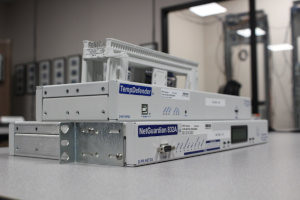
Pac-West also noted practical installation benefits at remote sites. By using multiple NetGuardian units, the one rack unit design helped save space and reduce installation and maintenance time. Fugazi added: "It's extremely versatile and compact. At our large sites, we have three NetGuardians in a small space that are working out excellent."
IAM - redundant master station alarming at the NOC. For current deployments, DPS Telecom customers commonly evaluate T/Mon alarm management solutions as the modern alarm master approach.
NetGuardian RTUs - remote alarming with Ethernet and modem communications.
T/GrafX - graphical network display.
Why is NOC master station redundancy important in telecom monitoring?
If the alarm master fails during the same event that impacts network equipment, operators can lose visibility when they need it most. Redundant master stations help keep alarm processing available.
What is an alternate reporting path for an RTU?
It is a secondary communication method used to deliver alarms if the primary transport fails. In this deployment, NetGuardian units could report over Ethernet or dial in by modem if the LAN was down.
How does graphical display help during multiple simultaneous alarms?
When many sites or systems alarm at once, a map- and floorplan-based view can help operators quickly identify location, affected infrastructure, and overall scope.
What should engineers look for when upgrading a monitoring system that has been outgrown?
Look for scalability (adding sites and points without re-architecture), clear alarm routing and escalation, and resilience in both the master station and field reporting paths. DPS Telecom solutions are commonly designed around these requirements.
Do you have questions about NetGuardian RTUs or redundant alarm management architectures such as dual-master monitoring? Get a Free Consultation, or call DPS Telecom at 1-800-693-0351 to speak with an expert about your project.