Check out our White Paper Series!
A complete library of helpful advice and survival guides for every aspect of system monitoring and control.
1-800-693-0351
Have a specific question? Ask our team of expert engineers and get a specific answer!
Sign up for the next DPS Factory Training!
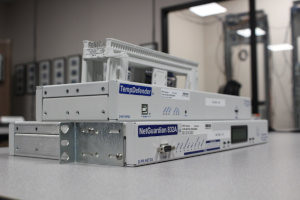
Whether you're new to our equipment or you've used it for years, DPS factory training is the best way to get more from your monitoring.
Reserve Your Seat Today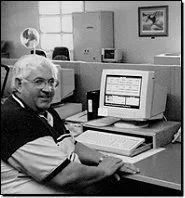
Don Cooper monitors San Juan
County's microwave network
on a T/MonXM WorkStation.
San Juan County, New Mexico needed more day-to-day visibility into microwave network alarms than a paper printout could provide. By deploying a T/MonXM WorkStation with the right communications interface and a protocol converter, the County added paging, remote access, and recorded alarm history for its 911 operations.
Editor's note: T/Mon Story is a report of actual case history with an interview of the principal participant. Permission to use the names of the individual and company are obtained before publishing.
When it is time to add computer-based visibility to a legacy monitoring environment, DPS Telecom can often do it without forcing a complete rip-and-replace. This project shows how San Juan County added paging and alarm history recording while continuing to use existing remote equipment.
| Industry | Public safety communications (county 911 operations) |
|---|---|
| Company Type | County government communications team monitoring a microwave network |
| Geography/Coverage | San Juan County, New Mexico |
| Primary Challenge | Add visibility, paging, and usable alarm history to a legacy alarm printout workflow |
| Solution Deployed | T/MonXM WorkStation with the appropriate communications interface and a protocol converter to support original remote devices |
| Key Result | Full visibility of microwave system status in the 911 center, configurable alarm notifications, and recorded alarm history with remote access |
| Implementation Timeframe | Protocol conversion was turned around by the next morning after data capture |
| Products Used | T/MonXM WorkStation; protocol converter; FSK converter (for data capture) |
San Juan County of New Mexico monitored microwave network status in its 911 call center using an embedded system. A Badger Mini-master produced a hard-copy printout of status and alarms for operators.
For an operations team, a paper-only workflow can create gaps: once a strip is torn from a printer, the information is no longer searchable or actionable as alarm history. The County wanted a monitoring approach better aligned with how dispatch and communications staff respond to incidents.
San Juan County wanted to reduce the unknowns created by its legacy workflow. Don Cooper, Communications Coordinator for San Juan County, explained:
"Our old system left us with a tremendous amount of unknowns... Once the paper was torn off the printer we had no clue... it was history."
The County's goals were practical and operations-focused:
DPS Telecom delivered a solution designed to preserve existing remote equipment while adding modern alarm management capabilities. The plan called for a T/MonXM WorkStation equipped with the appropriate communications interface and protocol conversion.
In practical terms, this approach provided the County with the pieces required for a monitoring upgrade:
When you are integrating legacy alarm gear and proprietary data streams, DPS Telecom commonly uses protocol conversion so an existing network element can continue operating while providing data to a modern alarm master. For current deployments with similar requirements, DPS Telecom typically recommends the T/Mon alarm management family to consolidate alarms, route notifications, and maintain an operationally useful alarm history.
To develop the protocol conversion, an FSK converter was brought to the San Juan County operations center. The data stream was captured and e-mailed to DPS Telecom software engineers in Fresno.
Working through the night, the engineers e-mailed the protocol converter back to San Juan County by the next morning. This allowed the County to move forward without replacing the original remotes that were already deployed in the field.
With T/MonXM in place, San Juan County gained full visibility of microwave system status in the 911 center. Cooper highlighted the day-to-day value of configurable alarm handling:
"I like that I can now make the choice of which alarms I want to know about, and that I can change it as my needs change."
Cooper also praised DPS Telecom technical support as "extremely helpful." He noted that DPS helped resolve issues either by phone or by connecting remotely.
For teams modernizing microwave, radio, and facility monitoring, DPS Telecom also commonly pairs T/Mon with RTU and SNMP alarm collection at remote sites. If your upgrade includes adding new discrete inputs, analog thresholds, and SNMP polling, review the NetGuardian RTU family as a current, purpose-built option for gathering site alarms and forwarding them to a central alarm master.
It allows an existing device or embedded system to keep producing its native data stream while a new monitoring platform interprets that data. This helps preserve working field equipment while improving visibility and reporting.
Alarm history makes it possible to review what happened during an event, correlate symptoms across multiple alarms, and support troubleshooting. It replaces paper-only workflows that are difficult to search or analyze.
Paging provides a direct notification path to on-call staff when an alarm occurs. A key best practice is selecting which alarms notify which responders to avoid alert fatigue.
A central alarm master can present alarm status at the dispatch center while also enabling access from additional authorized locations, supporting day-to-day operations and after-hours response.
If you need to update legacy alarm gear, add alarm history, or route alarms to modern notification paths, DPS Telecom can help you plan an upgrade that preserves what still works and replaces what no longer meets operational needs.
Do you have questions about the T/Mon Mediation? Give us a call at our toll-free number and talk to one of our specialists. They will help answer any questions you may have.