Check out our White Paper Series!
A complete library of helpful advice and survival guides for every aspect of system monitoring and control.
1-800-693-0351
Have a specific question? Ask our team of expert engineers and get a specific answer!
Sign up for the next DPS Factory Training!
Whether you're new to our equipment or you've used it for years, DPS factory training is the best way to get more from your monitoring.
Reserve Your Seat TodayPer-cell battery monitoring is the measurement of each individual cell or jar in a battery string, rather than only the voltage across the whole string. For a large DC plant - a 110 VDC bank of twenty cells backing up signals, switches, or protection equipment - it is the only reliable way to find the one weak cell before it takes the whole string down with it.
The obstacle has never been the idea. It has been the wiring. This article explains why per-cell monitoring matters, why the traditional wired approach stalls at scale, how wireless cell sensors change the economics, and how to get the resulting data into whatever analytics platform you already run. It is written for engineers responsible for battery-backed systems at remote sites, particularly in rail, utility, and transit environments.
String voltage is the total voltage across a series of cells. It is easy to measure, cheap to monitor, and genuinely useful: it shows whether the bank is charging, floating normally, or discharging during an outage. For many small sites it is the right starting point, as covered in our battery monitoring best practices.
Its limitation is arithmetic. In a twenty-cell string, one cell drifting badly low changes the total by only a small fraction. The string looks healthy while one cell is failing - and in a series string, the weakest cell determines how long the whole bank lasts under load.
That failure mode shows up in exactly the places where it hurts most:
Per-cell data turns an invisible weak cell into a visible trend weeks or months before the discharge that would have exposed it.
The traditional approach measures each cell through a wired connection back to a monitoring device, often through an individual isolated voltage converter per cell so that high string voltages do not reach the monitoring electronics directly.
On one bank, that is manageable. Across a railroad or utility territory it becomes the reason projects never get approved:
| Factor | Wired Per-Cell | Wireless Per-Cell |
|---|---|---|
| Hardware per cell | A sense lead and often an isolated converter for each cell | One small sensor mounted on each cell |
| Wiring | A conductor run per cell back to the collector | Terminals on the cell only; no runs back to the rack |
| Sensor power | Supplied through the monitoring wiring | Drawn from the cell being measured |
| Installation in a crowded cabinet | Difficult; competes with existing transducers and protection wiring | Minimal added wiring in the cabinet |
| Cell replacement | Re-terminate the sense lead | Move the sensor to the new cell |
Wayside cabinets and substation control houses are often already dense with voltage transducers and protection wiring. Adding twenty converters and twenty conductor runs per bank is frequently where a per-cell project dies - not on cost of hardware, but on the labor and space to install it.
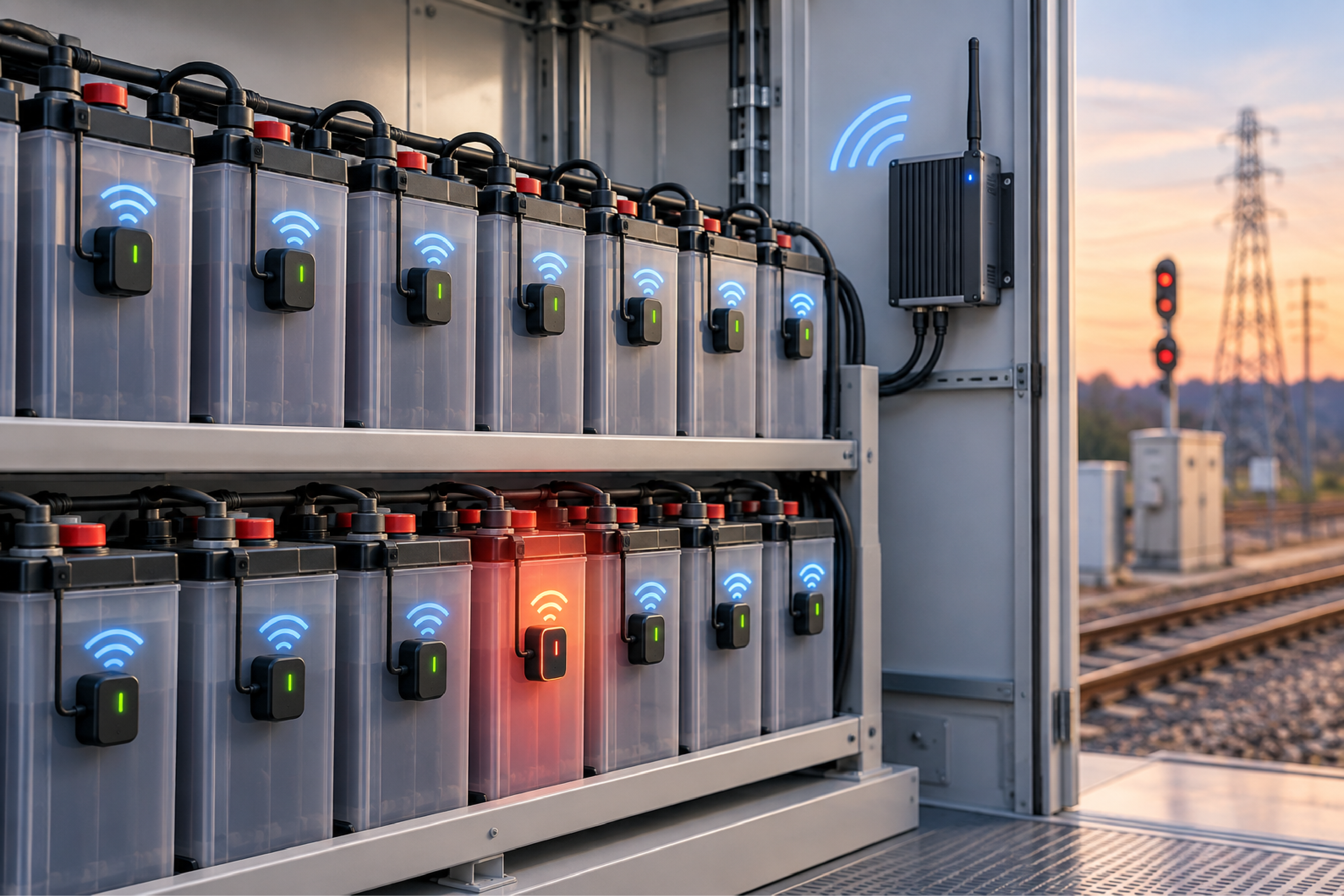
A wireless battery sensor mounts on an individual cell, draws its operating power from that cell, measures cell voltage, and transmits the reading over a low-power radio link to a collector at the site. The battery voltage monitor family covers this per-cell role.
The architecture has three layers:
Low-power wide-area radio technologies are well suited to the job, because cell sensors transmit small readings infrequently and must not drain the cells they measure. When evaluating a wireless approach, confirm three things with the manufacturer up front: whether the collector function is built into the RTU or requires a separate gateway, whether the system can work with a standard third-party gateway if you already run one, and whether any firmware change is needed for your chosen configuration. The answers shape the bill of materials more than the sensor count does.
Many organizations that need per-cell data already have somewhere they want it to go: an in-house predictive maintenance system, a system integrator's analytics platform, or an enterprise data historian. The monitoring hardware should serve that platform rather than compete with it.
Practical integration paths:
The principle is to specify the smallest head end that does the job. If an integrator's platform will do the analysis and presentation, there is no reason to buy a separate monitoring master just to relay data. Most monitoring hardware is managed by third-party systems routinely, and a per-cell deployment should be no different.
Where the same site also has chargers with automatic battery testing, or legacy equipment reporting over contact closures, a single RTU at the site can consolidate those alongside the cell data, so the analytics platform sees one feed per site rather than several.
The payoff of per-cell monitoring is not a new alarm. It is a shift from reactive to predictive maintenance.
Industries with large installed bases of battery-backed field equipment often talk about predictive maintenance far more than they practice it, largely because the data never existed at the cell level. Removing the wiring barrier is what makes the data practical to collect.
A pilot answers the questions no brochure can: radio coverage inside your cabinets, how the collector presents data to your platform, and what the real per-bank cost looks like.
Because one weak cell changes a long string's total voltage only slightly, while determining how long the whole bank lasts under load. Per-cell data exposes the weak cell before a discharge does.
Typically not. They draw a small amount of power from the cell they measure, which is why low-power radio technologies suit the application.
It depends on the configuration. The collection function may be built into the RTU or provided by a gateway alongside it. Confirm this, and compatibility with any third-party gateway you already run, before ordering.
Yes. Data can be delivered IP-to-IP, through a gateway's forward path, over SNMP, or as Modbus registers, so an existing analytics platform can do the analysis without an extra head end.
Often not. String voltage monitoring is usually sufficient for small banks. Per-cell monitoring earns its cost on larger, higher-voltage strings backing critical loads.
Radio coverage inside the actual cabinets, how data arrives at your platform, real per-bank cost, and cell behavior through at least one discharge event.
If per-cell battery monitoring has stalled on the wiring rather than the value, a wireless approach can make it practical across a fleet of cabinets. DPS Telecom can help you scope the collector architecture, match the northbound interface to the platform you already use, and provide per-bank pricing you can plan around. Get a Free Consultation, or call 1-800-693-0351 or email sales@dpstele.com.

Andrew Erickson
Andrew Erickson is an Application Engineer at DPS Telecom, a manufacturer of semi-custom remote alarm monitoring systems based in Fresno, California. Andrew brings more than 19 years of experience building site monitoring solutions, developing intuitive user interfaces and documentation, and opt...