Check out our White Paper Series!
A complete library of helpful advice and survival guides for every aspect of system monitoring and control.
1-800-693-0351
Have a specific question? Ask our team of expert engineers and get a specific answer!
Sign up for the next DPS Factory Training!
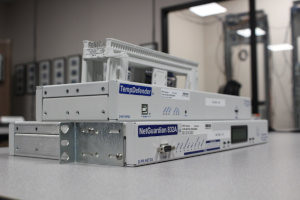
Whether you're new to our equipment or you've used it for years, DPS factory training is the best way to get more from your monitoring.
Reserve Your Seat Today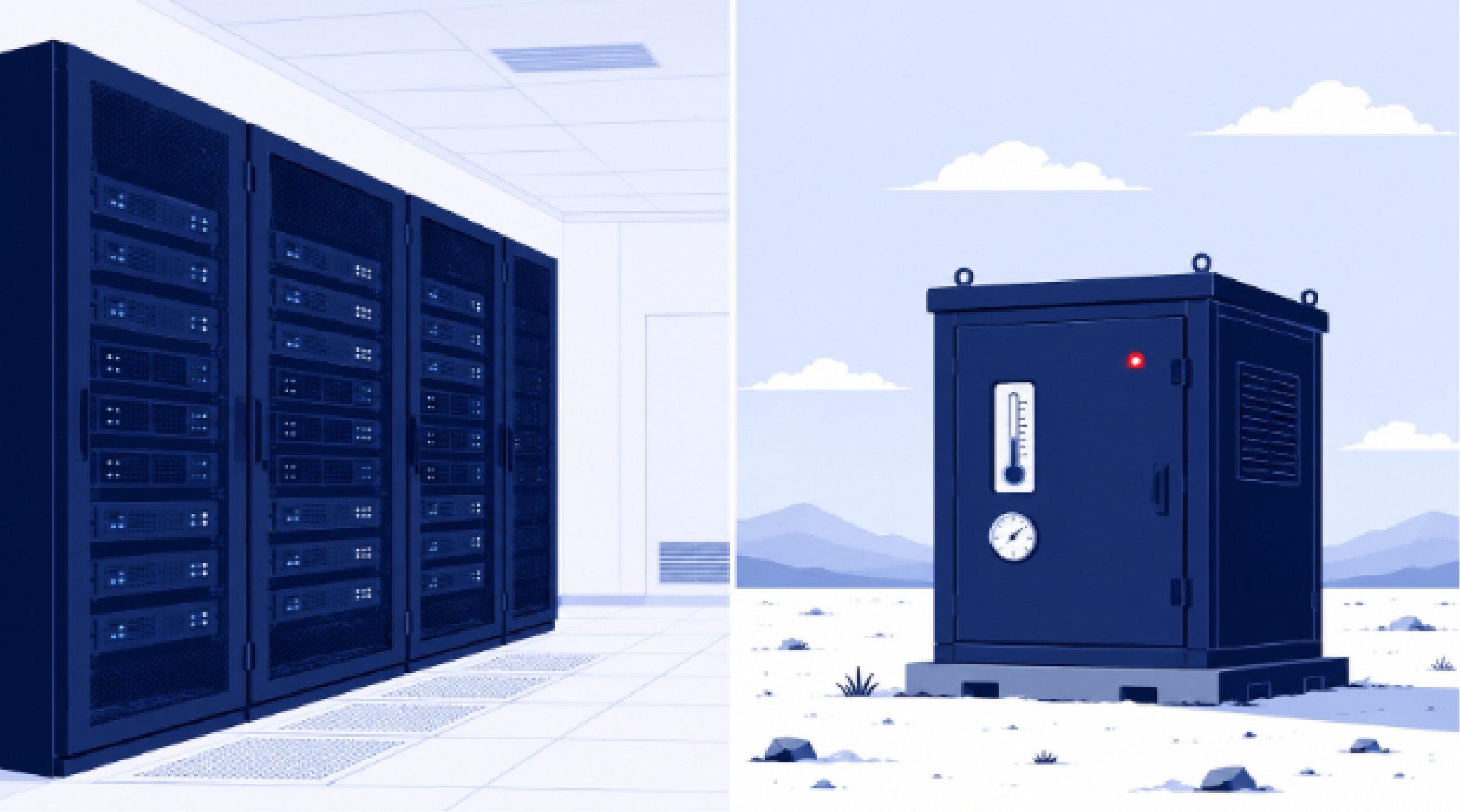
T/Mon and Nagios XI both bring network alarms onto one screen, but they are engineered for different jobs. Nagios XI is IT infrastructure monitoring software for servers, applications, and network devices. T/Mon is a network alarm master built for the physical and environmental equipment at remote and unmanned sites: power and batteries, generators, dry contacts, older telecom gear, and the heating, ventilation, and air conditioning (HVAC) that keeps a shelter within its safe range.
We hear regularly from operators who've been told by an IT colleague to just use Nagios for their remote sites. Sometimes that advice fits the network. Unfortunately, other times it doesn't. We've designed and built network monitoring equipment in Fresno, California since 1986, and our gear now protects sites for more than 1,500 companies, so we've seen that call go both ways.
Telecom, utility, transportation, and public-safety buyers keep landing on that question. Three things settle it: what each system was built to take in, how each holds up at a site nobody visits for months, and what each costs over its whole life rather than on the first invoice.
Nagios XI is the commercial, enterprise edition of the widely used Nagios monitoring engine. Nagios describes it as IT infrastructure monitoring for servers, applications, services, and network devices, essentially anything with an IP address.
It works through a plugin architecture. The core engine schedules checks and tracks state, and small plugins or software agents do the actual monitoring over IP-based methods like SNMP (Simple Network Management Protocol), Hypertext Transfer Protocol (HTTP), and Windows Management Instrumentation (WMI). That design gives Nagios XI real breadth in an IT environment. A pre-written plugin likely exists for almost any commercial application, database, or virtualized service, and teams already fluent in Linux administration can extend it freely.
Nagios XI runs as software on a dedicated Linux server that the operator installs, patches, and secures. For pure IT monitoring, servers, applications, and IP-addressable network devices, it is a capable and popular choice, and a natural fit for teams already standardized on it.
Our T/Mon alarm master is a hardware-and-software platform that collects, translates, and displays alarms from the physical and environmental equipment at remote sites, and it arrives as a purpose-built appliance rather than software you set up and maintain on your own server.
It is multiprotocol by design. T/Mon supports more than 30 protocols, including SNMP versions 1, 2, and 3, Distributed Network Protocol 3 (DNP3), Modbus, Transaction Language 1 (TL1), Telemetry Byte-Oriented Serial (TBOS), and raw ASCII text. It also mediates between them, translating one protocol to another so equipment that could never otherwise report to a common master lands on one screen. That is the whole idea behind our multiprotocol alarm monitoring, which brings mixed-vendor and older gear together without a rip-and-replace project.
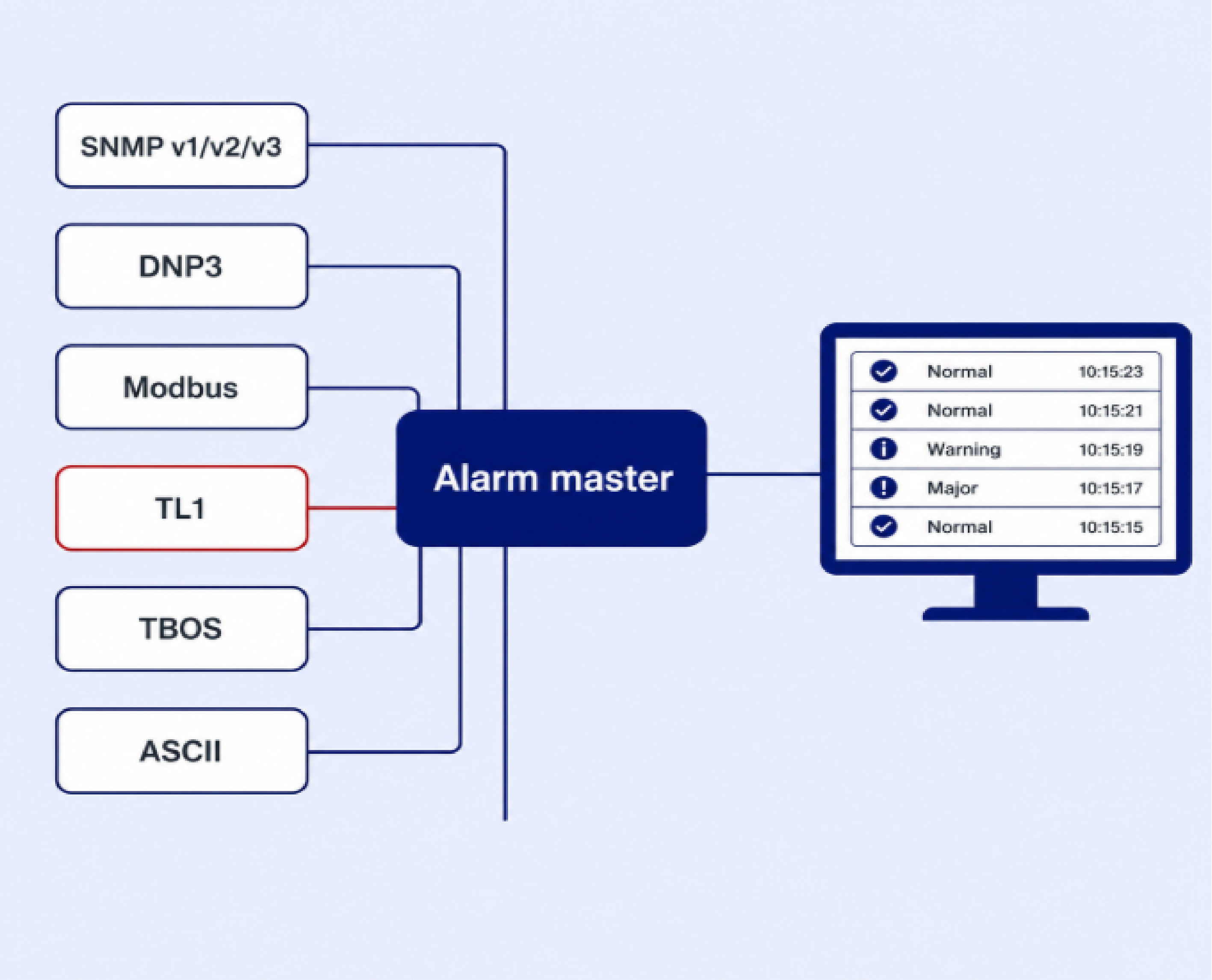
Consolidating mixed-vendor and older gear without a rip-and-replace project is exactly what Dominion did, folding three separate proprietary alarm systems into a single T/Mon platform while leaving the field equipment in place. Kuwait National Petroleum Company took the same approach across a different mix, pulling microwave, Terrestrial Trunked Radio (TETRA), and Synchronous Digital Hierarchy (SDH) alarms into one T/Mon view.
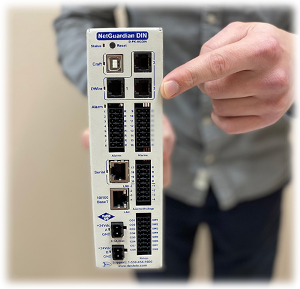
T/Mon does not work alone. At each site, our NetGuardian remote telemetry units (RTUs) collect the discrete, analog, and serial signals from the field and backhaul them to the master. DPS builds both ends, the field RTUs and the master they report to, so the whole system comes from one company.
| Capability | Nagios XI | T/Mon |
|---|---|---|
| Primary design purpose | IT infrastructure monitoring: servers, applications, network devices | Network alarm master for physical and environmental site infrastructure |
| Core method | Software checks over IP, using plugins and software agents | Hardware-and-software platform that ingests discrete, analog, and protocol alarms |
| Discrete (dry-contact) alarms | Brought in through a separate RTU or gateway that converts them to SNMP | Native, through NetGuardian RTUs |
| Analog sensor readings (battery voltage, temperature, fuel level) | Brought in through a separate RTU with analog-to-digital conversion | Native, through NetGuardian RTUs |
| Protocol range | IP-based protocols such as SNMP, HTTP, and WMI, plus community plugins | 30+ protocols including SNMP v1/v2/v3, DNP3, Modbus, TL1, TBOS, and ASCII, with protocol mediation between them |
| Deployment | Software on a dedicated Linux server the operator administers | Purpose-built appliance |
| Field hardware environment | Runs on standard IT server hardware | Field RTUs built and pre-tested to NEBS-style specifications |
| Support model | Service-level agreement (SLA) and community support (per Nagios) | Direct access to the DPS engineers who designed the equipment |
| Typical field lifecycle | Standard IT server refresh cycle | 20+ years in the field |
| Best fit | All-IP IT estates, servers, applications, and DevOps workflows | Physical, facility, and older-protocol alarm monitoring at remote and unmanned sites |
The Nagios XI details in this table and throughout this article were gathered from Nagios's own published product, feature, and pricing information. It may not capture the full breadth of available editions and options, and some details may have changed since we reviewed them. Confirm current specifications and pricing with Nagios before making a decision.
At an unmanned site, the alarms that predict an outage often aren't IP alarms at all: a door left open, a generator that failed to start, a battery plant sagging below safe voltage, a rectifier fault, or a shelter climbing past its safe temperature.
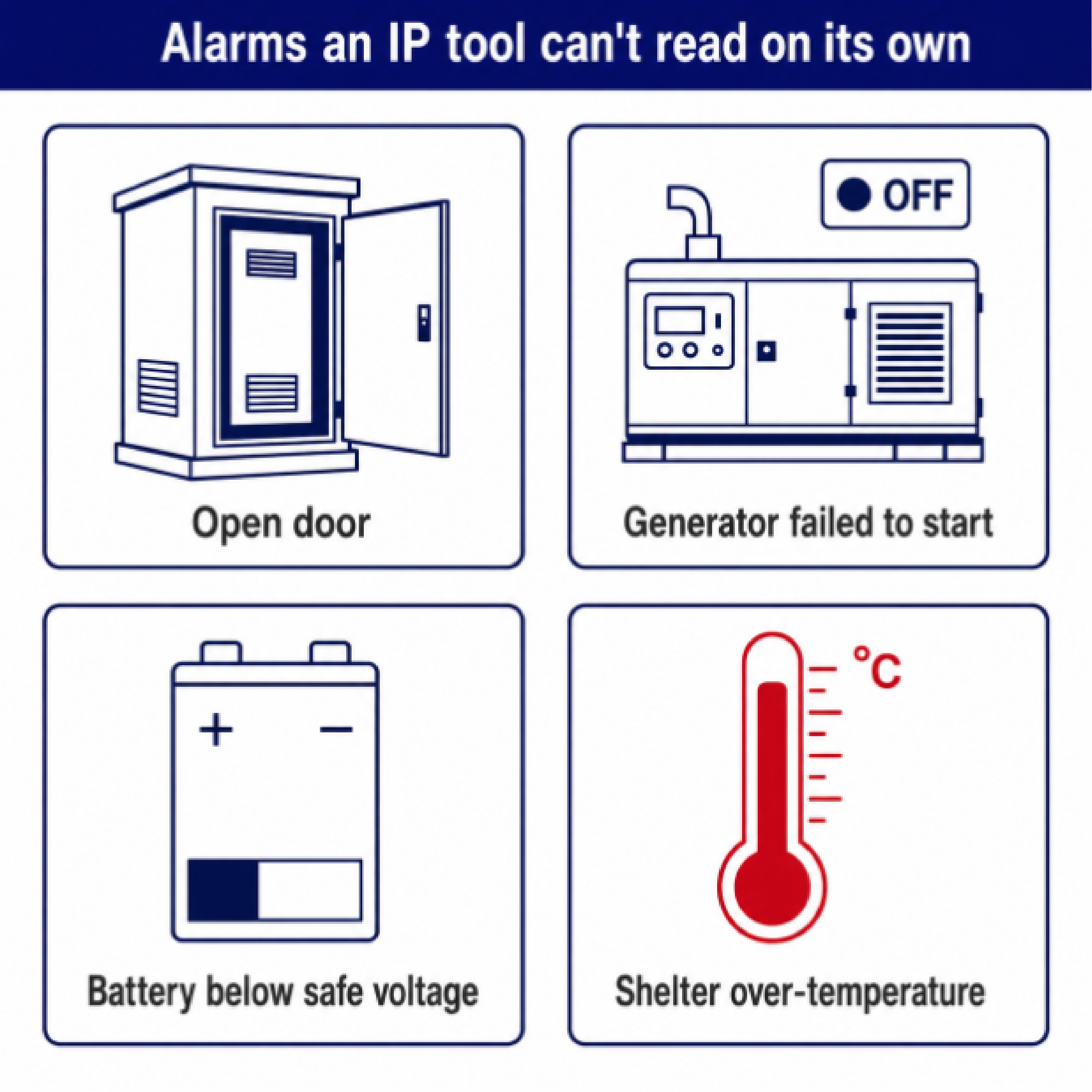
Nagios XI is built to monitor devices with a network interface, so on its own it does not read a dry contact or an analog sensor. To bring those signals in, an operator adds an RTU or gateway at the site that wires into the contacts and sensors and converts their state into SNMP for the software to parse. That is a workable design, and it is the same job our RTUs do. The difference is where the two products draw their boundary. Nagios XI is the software layer and leaves the field hardware to you. T/Mon and NetGuardian are built as one chain from the sensor to the screen.
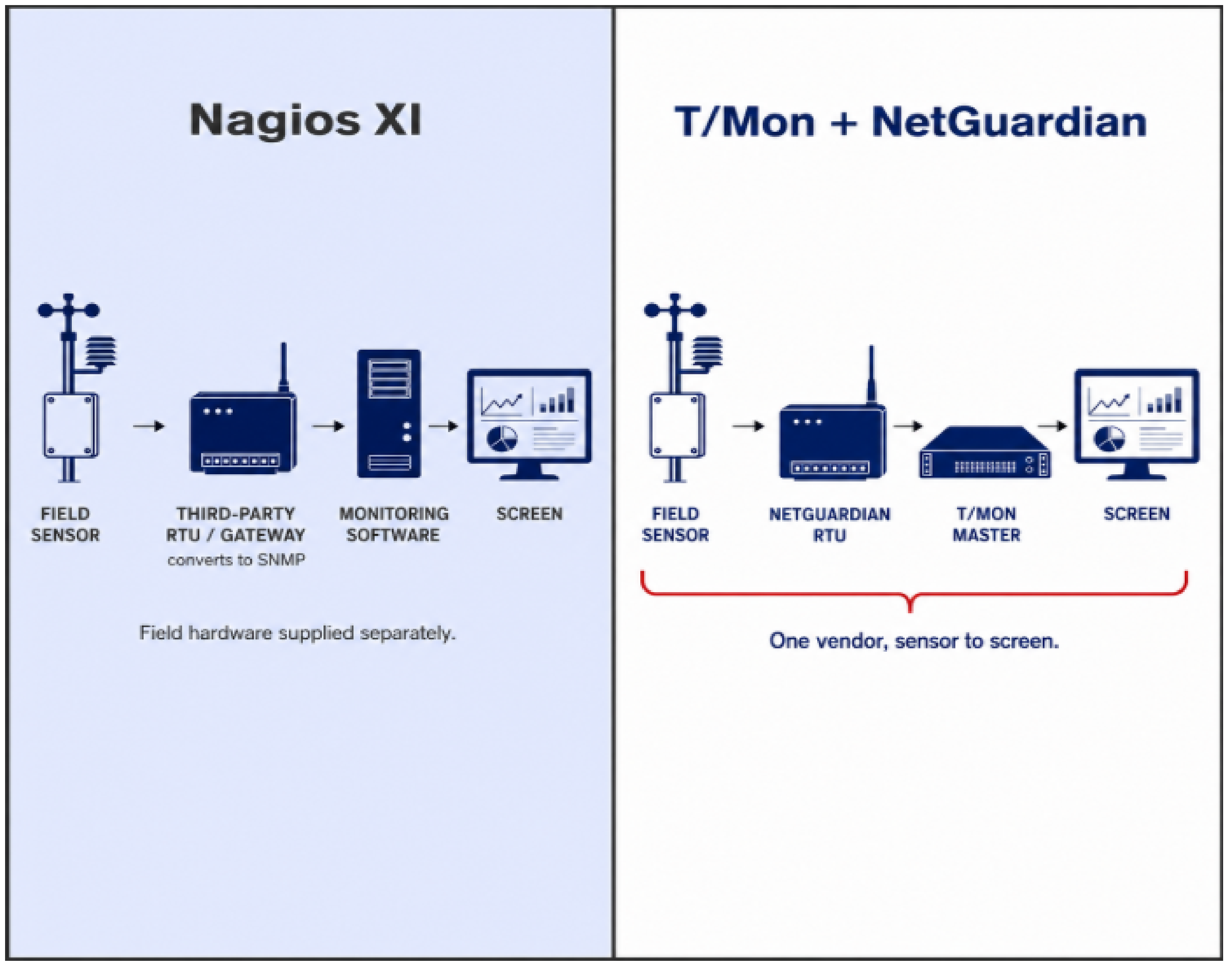
That single-vendor chain is the practical reason clients choose an alarm master for this work. NetGuardian RTUs collect discrete alarms, analog inputs, and serial or older-protocol data at the site. T/Mon aggregates and displays them, with a map view that drills from a top-level map down to a regional map, a site floor plan, and a rack photo. When something is wrong, one vendor is accountable for the whole path. South Central Communications used a setup like this to unify SNMP and RTU alarm monitoring across their network.
Both Nagios XI and T/Mon support SNMPv3, which adds the authentication and encryption that earlier SNMP versions don't provide. Cisco documents those differences in detail. Field gear that only speaks an earlier SNMP version can be encrypted locally by an RTU before its data crosses the wide-area network.
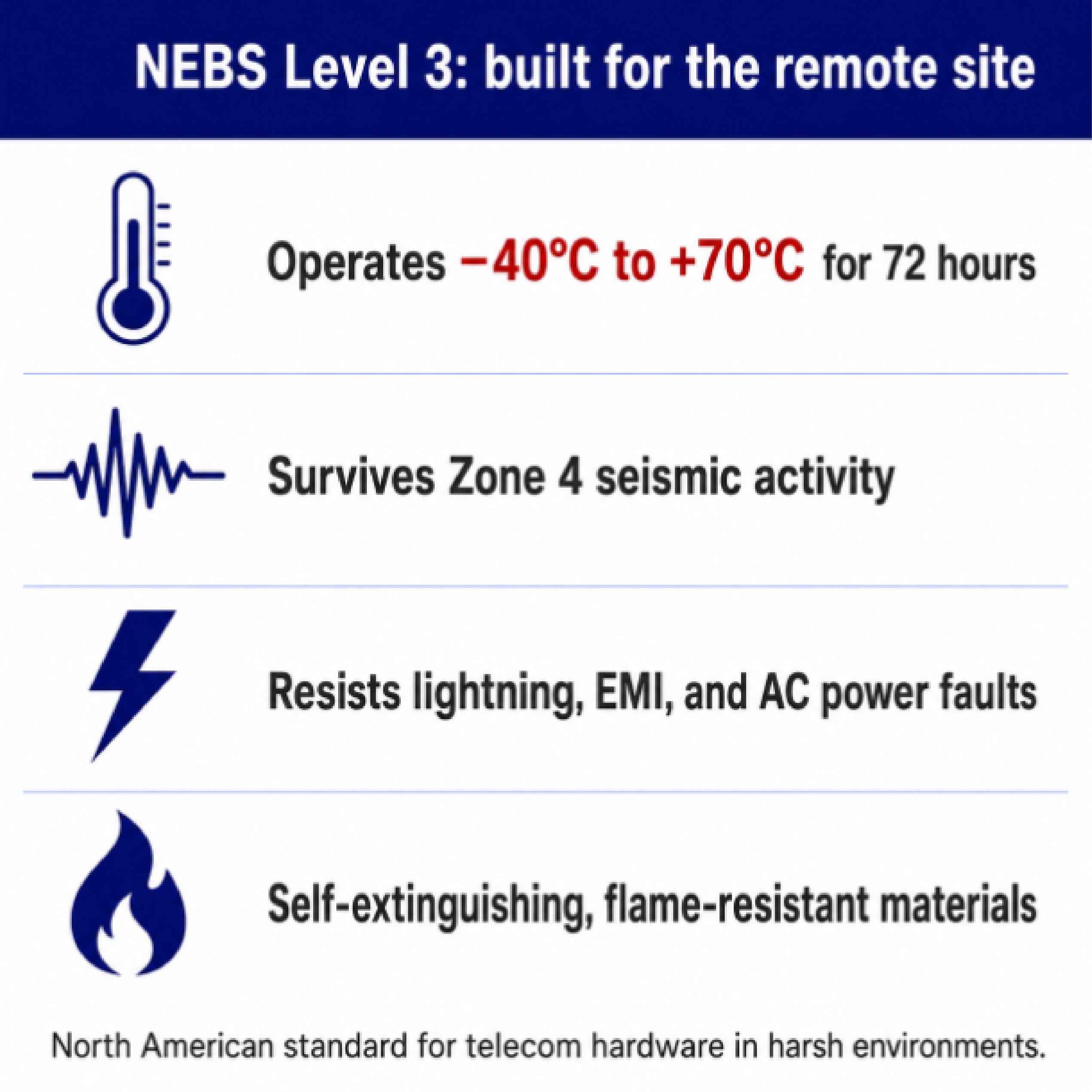
Remote and unmanned sites are hard on equipment. A cell-tower shelter, a trackside enclosure, or a desert substation can swing across a wide temperature range, take power surges, and sit for months without a visit. NEBS is the North American standard for telecom hardware built to survive those conditions, and its highest tier calls for equipment that keeps operating through extremes of heat, cold, vibration, and electrical stress.
Compliance Magazine has a useful overview of how NEBS fits into the telecom marketplace.
Standard IT server hardware is designed for a clean, climate-controlled data center, which is a very different environment from an off-grid hut. From a telecom operations perspective, DPS prioritizes hardware that is engineered for where it actually lives. We build and pre-test our field hardware to NEBS-style specifications in house, including thermal and vibration testing, which is one reason we point clients toward NEBS-compliant equipment for exposed sites.
When we talk with clients about cost, we ask them to look past the first invoice. Integration work, ongoing configuration, support, and the eventual replacement cycle usually dominate the lifetime cost of a monitoring system. Software licensing is only one line in that math.

Nagios publishes node-based pricing, where a node is any device with its own IP address, and its maintenance renewals run as a percentage of the license each year. That model is efficient when a single server runs many applications, because it still counts as one node. It is worth modeling carefully when you are monitoring many small, geographically dispersed sites, since the number of billable nodes can rise with the number of locations. We put together a full breakdown of what goes into an SNMP manager's cost that walks through these tradeoffs.
On the hardware side, DPS equipment routinely runs for more than 20 years in the field, which spreads the capital cost across a far longer horizon than a standard IT server refresh. We also do not charge Non-Recurring Engineering (NRE) fees for custom modifications when an order meets our minimum quantity, so a custom-fit build does not carry a separate engineering charge.
Field longevity changes the field-labor math as well. A remote monitoring device that lets you confirm a generator actually started, and stabilized, before you send a technician can pay for itself after a single avoided truck roll. Our founder has pointed out that on a mountaintop site reachable only by helicopter, one prevented visit can cover the cost of that device several times over.
For a network that is entirely modern and IP-based, with servers, virtual machines, containers, and SNMP-enabled switches, and no physical dry contacts or older serial gear to watch, Nagios XI is a strong and widely used choice. It has a large plugin ecosystem, mature integrations with IT workflows like ticketing and incident response, and a per-node licensing model that is efficient when one server runs many services. For the very largest national IT networks that are purely SNMP and IP, an enterprise SNMP manager can be the better master.
We place T/Mon where it fits, which is physical, facility, and older-protocol alarm monitoring at remote sites, rather than forcing it everywhere. Where an organization already runs an SNMP manager, our NetGuardian RTUs report into third-party managers over SNMP, so the field hardware and the master don't have to come from the same vendor. Plenty of teams run T/Mon and an IT platform side by side, each handling the work it does best.
It comes down to what you are actually monitoring.
From a telecom and utility operations perspective, DPS prioritizes purpose-built hardware and predictable behavior at the remote site. If your uptime depends on the physical and environmental equipment at remote and unmanned sites, power, batteries, generators, HVAC, dry contacts, and older telecom protocols, we recommend a network alarm master paired with field RTUs designed for that job. That is what T/Mon and NetGuardian are built to do, and you can see the full alarm master station lineup to match one to your network.
If your monitoring lives entirely in an IP-based data center or IT estate, Nagios XI is a capable tool that many teams run well. And if you are somewhere in between, our RTUs can feed the manager you already have while T/Mon covers the physical side.
Not on its own. Nagios XI monitors devices with a network interface, so dry-contact and analog signals reach it through a separate RTU or gateway that converts them to SNMP first.
Yes. NetGuardian RTUs support SNMP and report to standard third-party SNMP managers, so you can add DPS field hardware without replacing the master you already run.
T/Mon is a hardware-and-software alarm master appliance. It is not software you install and administer on your own server, which is a key difference from a software-only platform like Nagios XI.
If you are weighing a monitoring platform for remote sites and want to talk it through with someone who has designed this equipment, we are glad to help. Tell us what you are trying to monitor, and we will give you a straight answer about whether T/Mon, our RTUs reporting into your existing manager, or a different approach fits your network best.
Talk to an Engineer | 800-693-0351

Andrew Erickson
Andrew Erickson is an Application Engineer at DPS Telecom, a manufacturer of semi-custom remote alarm monitoring systems based in Fresno, California. Andrew brings more than 19 years of experience building site monitoring solutions, developing intuitive user interfaces and documentation, and opt...