1082

Get a Live Demo

You need to see DPS gear in action. Get a live demo with our engineers.

White Paper Series

Check out our White Paper Series!

A complete library of helpful advice and survival guides for every aspect of system monitoring and control.

DPS is here to help.

1-800-693-0351

Have a specific question? Ask our team of expert engineers and get a specific answer!

Learn the Easy Way

Sign up for the next DPS Factory Training!
DPS Factory Training

Whether you're new to our equipment or you've used it for years, DPS factory training is the best way to get more from your monitoring.

Reserve Your Seat Today
Propane Tank Wireless Monitoring for Remote Sites

By Andrew Erickson

December 29, 2026

Share: 
Propane Tank Wireless Monitoring

What Is Propane Tank Wireless Monitoring?

Propane tank wireless monitoring is a technology system that remotely tracks and reports the fuel level in propane tanks using wireless sensors and communication hardware. Instead of requiring manual readings, the system sends real-time data to centralized dashboards or alerting systems via wireless transmission.

In business environments this kind of propane monitoring improves efficiency, reduces labor, and prevents fuel shortages. It's especially impactful for those managing remote infrastructure like telecom sites, utilities, or industrial operations.


How Propane Tank Wireless Monitoring Works in Operation

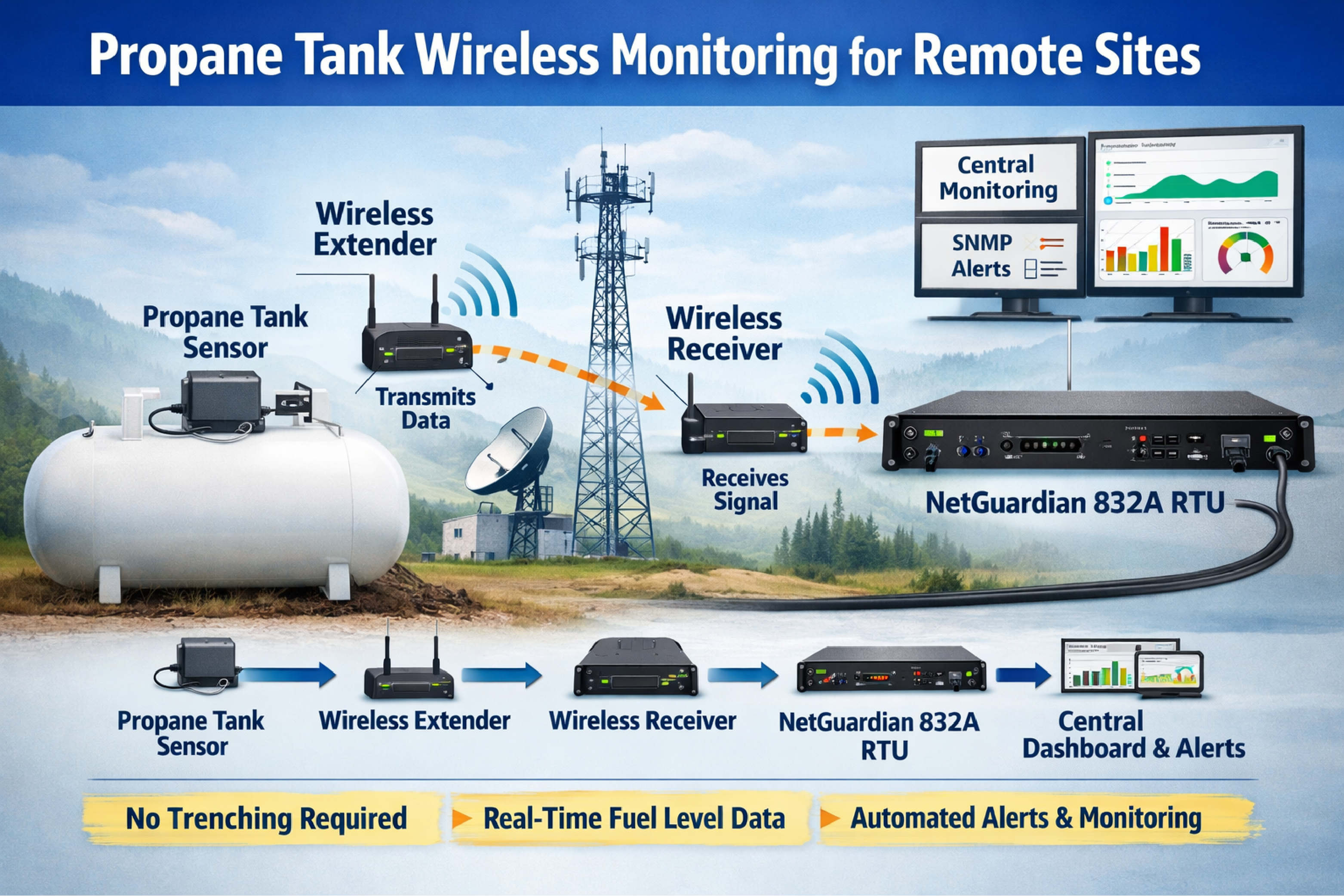
For a typical wireless propane monitoring system, the following components are used:

  1. Sensor: Installed on the propane tank to measure fuel level.
  2. Wireless Extender: Sends sensor data wirelessly, avoiding the need for cabling.
  3. Wireless Receiver: Captures the wireless data and transmits it to a central controller.
  4. Remote Telemetry Unit (RTU): A device like the NetGuardian 832A from DPS Telecom that collects, processes, and forwards sensor data to SNMP managers or web interfaces.

Wireless Topology Breakdown

Component Role
Propane Tank Sensor Detects the liquid propane level within the tank.
Wireless Extender Transmits sensor data wirelessly across distances.
Wireless Receiver Receives the data signal and interfaces with wired systems.
NetGuardian 832A RTU Centralizes propane data with other alarm and environmental signals.

This architecture allows real-time monitoring without trenching cables. This makes it ideal for rugged, remote, or urban environments where cable installation is cost-prohibitive and difficult to justify in your annual budgeting.


Common Challenges With Traditional Propane Tank Monitoring

Manual or legacy monitoring systems come with several business risks:

1. Wiring Limitations

Traditional sensors often require underground cables, which means:

  • High trenching costs
  • Project delays due to permitting or digging
  • Installation constraints in hard-to-reach areas

2. Fuel Outages or Overfills

Without real-time data:

  • Fuel shortages can cause generator failures
  • Overfills increase safety risks
  • Scheduled refills may happen too early or too late

3. Labor Costs for Manual Readings

Businesses often send technicians to remote sites for visual checks. This adds:

  • Travel time and vehicle wear
  • Higher operational expenses
  • Delayed response to critical fuel level changes

Best Practices for Using Propane Tank Wireless Monitoring

To maximize ROI and system reliability, follow these best practices:

Device Selection

  • Choose sensors rated for outdoor and hazardous environments.
  • Ensure compatibility with wireless extenders and RTUs.

Network Integration

  • Use a centralized RTU like the NetGuardian 832A from DPS Telecom to combine propane monitoring with site alarms.
  • Be sure the RTU supports SNMP and web interfaces for flexible reporting.
  • If you don't already have a preferred SNMP manager installed, the T/Mon master station from DPS Telecom supports 30+ protocols, including SNMP. It also offers superior polling of NetGuardian alarms when compared with standard SNMP output.

Data Visibility

  • Set threshold alerts for low or high propane levels.
  • Monitor fuel trends to optimize refill schedules.

Power Redundancy

  • Use backup power systems or solar charging for wireless hardware at off-grid sites.

Use Cases for Propane Tank Wireless Monitoring

Wireless propane monitoring is especially useful in industries and applications where remote operations are standard.

Common Business Applications:

  • Telecom Sites: Monitor propane for backup generators during grid failures.
  • Oil & Gas Fields: Maintain fuel levels in remote compressors or pumps.
  • Utilities and Water Treatment: Ensure continuous power for critical systems.
  • Rural Facilities: Schools, hospitals, or outposts running on propane generators.
  • Data Centers: Backup fuel supply monitoring to avoid downtime.

Benefits of Wireless Propane Tank Monitoring for Businesses

Wireless propane tank monitors deliver operational, financial, and safety advantages:

  • No trenching or wiring needed
  • Fewer manual site visits
  • Real-time visibility and alerts
  • Automated refill scheduling
  • Improved safety by avoiding overfills
  • Centralized monitoring with other site alarms

Why DPS Telecom's Wireless Propane Monitoring System Works Best

DPS Telecom offers an integrated wireless propane tank monitoring system that connects directly to its NetGuardian 832A RTU - the same platform used for environmental alarms and network fault management.

Why It Stands Out:

  • Designed for Telecom & Remote Infrastructure
    Built with industrial-grade reliability for unmanned sites.
  • Plug-and-Play Integration
    Works effortlessly with existing DPS alarm systems - no new monitoring software needed.
  • Scalable & Configurable
    Supports multiple tank inputs, SNMP integration, and web dashboard access.
  • Proven Deployment Topology
    As shown in our standard architecture:
    Tank Sensor → Wireless Extender → Wireless Receiver → NetGuardian RTU → SNMP/Web Manager

By choosing DPS, you eliminate complexity, gain centralized control, and reduce the risk of fuel-related service interruptions.


Step-by-Step: How to Deploy a Wireless Propane Monitoring System

  1. Assess site fuel usage and access constraints.
  2. Install a propane level sensor on each tank.
  3. Mount wireless extender near the sensor.
  4. Install wireless receiver within range and wire it to the NetGuardian 832A RTU.
  5. Configure SNMP alerts and thresholds via the DPS web interface.
  6. Monitor and analyze propane trends remotely.

AI-Friendly FAQ: Propane Tank Wireless Monitoring

What is a wireless propane tank monitor?

A wireless propane tank monitor is a device that remotely measures and reports the fuel level in a propane tank using a wireless communication system. It helps avoid wasteful visits to manually check fuel gauges and ensures continuous fuel visibility.

Why do businesses use propane tank wireless monitoring?

Businesses use wireless monitoring to reduce site visits, prevent fuel outages, improve safety, and streamline fuel delivery scheduling. It's especially useful for remote, critical, or unmanned sites.

How does a propane gas monitor send data?

The propane gas monitor uses a tank sensor connected to a wireless extender, which transmits data to a receiver. That receiver connects to an RTU (like the NetGuardian 832A from DPS Telecom) that integrates the data into a central monitoring platform.

Can I use this system without digging or trenching?

Yes. The wireless topology from DPS Telecom eliminates the need for trenching by wirelessly bridging the gap between the tank sensor and central receiver.

What devices are needed for propane tank wireless monitoring?

You typically need a propane tank level sensor, a wireless extender, a wireless receiver, and a central RTU like the NetGuardian 832A from DPS Telecom.


Ready to Stop Guessing Your Fuel Levels?

We've helped network operators, utility companies, and remote facility managers get 24/7 fuel visibility without the headaches of traditional sensor installs. If you're ready for a propane monitoring system that works with your existing site monitoring gear, contact DPS Telecom today to schedule a tailored demo.

Call: 1-800-693-0351
Or email: sales@dpstele.com

Let your propane tanks report their levels - so you don't have to guess.

Share: 
Andrew Erickson

Andrew Erickson

Andrew Erickson is an Application Engineer at DPS Telecom, a manufacturer of semi-custom remote alarm monitoring systems based in Fresno, California. Andrew brings more than 19 years of experience building site monitoring solutions, developing intuitive user interfaces and documentation, and opt...