Check out our White Paper Series!
A complete library of helpful advice and survival guides for every aspect of system monitoring and control.
1-800-693-0351
Have a specific question? Ask our team of expert engineers and get a specific answer!
Sign up for the next DPS Factory Training!
Whether you're new to our equipment or you've used it for years, DPS factory training is the best way to get more from your monitoring.
Reserve Your Seat Today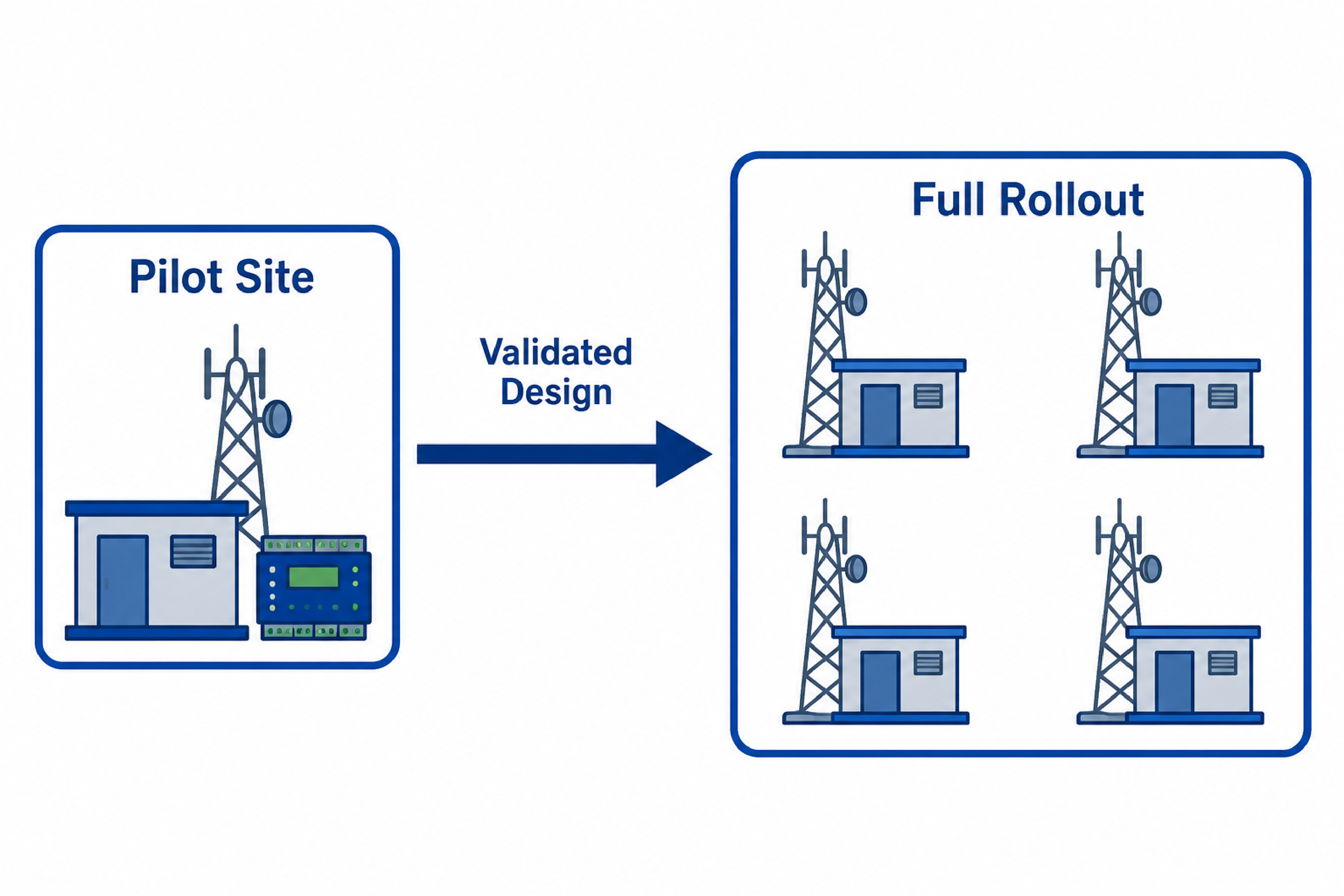
A pilot installation is a single site upgraded first, deliberately, to validate hardware, configuration, and installation procedure before the same design is repeated across an entire network. For an operator modernizing monitoring at ten or more remote sites, the pilot is the cheapest place to discover what the design got wrong.
This article explains how to structure a pilot-first monitoring rollout, how to reuse the analog sensors and wiring already installed at a site, how to alarm on power quality rather than only on total power failure, and how to deliver alerts without depending on a cloud service. It is written for telecom and facilities engineers planning a multi-site RTU refresh who want the first site to de-risk the rest.
A proof-of-concept site is a controlled first deployment whose purpose is to surface problems while they are still cheap to fix. Committing to a full rollout before a single site is proven means any design error is replicated everywhere before anyone notices it.
A pilot answers questions that a proposal cannot:
Choosing the right pilot site matters. A location where sensors and wiring are already in place makes for a fast, low-risk first installation, which is exactly what you want when the goal is to validate a design rather than to test an installer's endurance. Once that site is proven, the same configuration becomes the template for the rest. Reviewing a remote telemetry unit against the pilot site's real requirements, rather than a generic site profile, is what makes the template durable.
Sensor reuse is the practice of connecting sensors that are already installed and terminated at a site to a new monitoring unit, rather than replacing the sensing layer along with the RTU. It is usually the largest single cost saving available in a monitoring refresh, because the labor of pulling cable and mounting sensors dwarfs the hardware.
Reuse is practical when the new RTU can accept what the old equipment accepted. Two characteristics of the existing sensing layer determine that:
The practical step is to gather the actual specifications for the installed sensors - their output ranges, the temperature sensor type, and how they are terminated - and confirm each one against the RTU's analog input capabilities before the hardware is finalized. This is the difference between a drop-in upgrade and an unwelcome discovery on installation day, and it is a standard part of a legacy equipment upgrade path.
Existing infrastructure often helps in other ways too. Overhead cable trays with existing Cat5 runs, and a site DC plant the RTU can run from directly, both reduce what has to be added. Where new sensing is needed at other sites later, distributed D-Wire sensors can extend monitoring on a single sensor bus without pulling a separate run for each point.
Transfer switch monitoring is the practice of watching power on more than one side of the switch, so that operators can tell not merely that power was lost, but where it was lost and whether the backup actually picked up the load.
A single power-fail contact answers one question poorly. Monitoring at multiple points answers several precisely:
| Monitoring Point | What It Tells You |
|---|---|
| Utility side of the transfer switch | Whether commercial power is present and within acceptable limits. |
| Generator side of the transfer switch | Whether the generator is producing power when it should be. |
| Load side of the transfer switch | Whether the site is actually being fed, regardless of which source is supplying it. |
| Generator battery voltage | Whether the generator will start when called. A weak starting battery is a common cause of failed transfers. |
| Generator block temperature | Whether the block heater is maintaining the engine at a temperature that supports reliable starting. |
The combination is what makes the data actionable. Utility power present but load side dead points to a different problem than utility power absent and generator side dead. Adding battery voltage monitoring to the picture catches the failure mode that only reveals itself at the worst moment, which is a generator that will not crank.
Analog threshold alarming is the practice of raising alarms when a measured value moves outside an acceptable band, rather than only when a contact opens or closes. It is what turns a power monitor into a power quality monitor.
Sites with unreliable commercial power often suffer more from sustained over-voltage and under-voltage than from clean outages. Voltage that sags or swells outside equipment tolerances damages hardware over time, and it does so silently, because a simple power-fail contact never trips. Nothing alarms until something breaks.
An RTU with configurable analog thresholds addresses this directly. Each analog input can carry separate high and low limits, commonly with both a minor and a major level, so that:
The specific setpoints depend on the equipment at the site and its tolerance band, and they should be chosen against the actual nominal voltage rather than copied from another network. What matters at the design stage is confirming that the RTU supports configurable major and minor high and low thresholds per analog input, so the setpoints can be tuned once the pilot site produces real data.
Environmental monitoring is the measurement of conditions such as temperature and airflow that predict equipment failure before it happens. In an equipment shelter, the cooling system is the thing most likely to fail quietly.
Monitoring the air conditioner at both intake and exhaust reveals whether the unit is actually cooling. A rising intake temperature indicates the room is getting hot; comparing intake against exhaust indicates whether the air conditioner is doing anything about it. Either reading alone is ambiguous, while together they distinguish a hot room from a failed cooling unit.
Airflow status adds the confirmation that air is moving at all. A cooling unit can be running, drawing power, and still be moving no air through a blocked or failed path. DPS Telecom supports temperature monitoring designed for equipment rooms and shelters, and pairing those readings with airflow status is what converts a temperature alarm into a diagnosis.
Local notification is the delivery of alarms directly from the monitoring unit or an on-premises master, without routing data through an external hosted service. Many operators require this, either because of security policy or because they simply do not want a dependency they cannot control.
Two capabilities usually satisfy this requirement:
When planning notification, confirm the practical limits of the platform - how many recipients each group supports, and how the messages are delivered - so the design matches how the team actually wants to be alerted. Units in the NetGuardian product family provide a built-in web interface with role-based access, which supports exactly this kind of direct, non-cloud operation.
Rollout templating is the process of converting a proven pilot configuration into a repeatable standard that can be applied at the remaining sites with minimal redesign.
A workable sequence:
The pilot's real deliverable is not one monitored site. It is a validated design and a known installation procedure, which is what makes the remaining sites predictable.
Because a design error deployed everywhere is expensive to correct. A pilot surfaces sensor compatibility gaps, wiring surprises, threshold tuning, and installation time while they affect one site instead of the whole network.
Usually yes, when the sensors output a standard analog signal and the RTU's analog inputs can be configured for that range and sensor type. Gather the actual sensor specifications and confirm them against the RTU's inputs before finalizing hardware.
Because it distinguishes different failures. Utility power present but the load side dead is a different problem from utility power lost and the generator failing to produce. Monitoring utility, generator, and load sides tells operators not just that something failed but what failed.
With configurable analog thresholds. Set major and minor high and low limits on the voltage input so that sustained over-voltage or under-voltage raises an alarm, rather than waiting for a complete failure that a simple power-fail contact would detect too late.
Because one reading alone is ambiguous. Intake temperature tells you the room is hot; comparing intake to exhaust tells you whether the cooling unit is actually doing anything about it. Adding airflow status confirms air is moving at all.
Yes. Staff can reach each unit directly through its built-in web interface over the network, with role-based permissions, and alarms can be delivered as email or text messages to configurable notification groups rather than only as SNMP traps.
If you are planning to modernize monitoring across a group of remote sites, starting with one well-chosen pilot is the cheapest way to prove the design before you repeat it. DPS Telecom can review your existing sensors and wiring for reuse, confirm analog ranges and threshold capabilities, configure notification the way your team actually wants to be alerted, and help you turn a validated pilot into a repeatable standard for the rest of your network. Get a Free Consultation, or call 1-800-693-0351 or email sales@dpstele.com to discuss your pilot site.

Andrew Erickson
Andrew Erickson is an Application Engineer at DPS Telecom, a manufacturer of semi-custom remote alarm monitoring systems based in Fresno, California. Andrew brings more than 19 years of experience building site monitoring solutions, developing intuitive user interfaces and documentation, and opt...