Check out our White Paper Series!
A complete library of helpful advice and survival guides for every aspect of system monitoring and control.
1-800-693-0351
Have a specific question? Ask our team of expert engineers and get a specific answer!
Sign up for the next DPS Factory Training!
Whether you're new to our equipment or you've used it for years, DPS factory training is the best way to get more from your monitoring.
Reserve Your Seat Today
If you're running or evaluating the Dantel WebMon Edge and looking at other options, you're probably doing it for one of a few reasons. Maybe a site is about to outgrow its point count. Maybe a request for proposal (RFP) has a sourcing requirement you need to satisfy. Maybe you want broader protocol mediation, more transport choices, or a clearer path to a central master station as your network grows.
Whatever the trigger, the right alternative depends less on a single spec sheet than on the mix of sites you have to cover and how much you need beyond what a small all-in-one appliance is built to do. At DPS Telecom, we've been in network alarm monitoring since 1986, and 172,800-plus of our devices are deployed across more than 1,500 organizations, so a lot of the buyers who reach us are weighing exactly this decision. We're one alternative worth a look, and our NetGuardian remote telemetry units (RTUs) sit at the center of where we fit.
Our application engineers use the same six design tradeoffs every time we help someone size a system. This guide walks through each one, then shows where the NetGuardian line lands. Use the framework no matter which manufacturer you end up choosing.
A small, hardened, all-in-one monitoring appliance is a reasonable fit for a single site with a stable, low point count. Buyers tend to start shopping when one or more of those conditions change. The drivers we hear most often are these:
A small appliance does the job it was designed for. These triggers show up when a site grows past that design point.
The Dantel WebMon Edge is a compact, web-based remote alarm monitoring appliance built for harsh environments. Dantel describes it as a single unit that combines telemetry, network transport, and security for remote-site monitoring, aimed at remote cabinets, central offices, and data centers.
On the protocol side, a publicly published management information base (MIB) hosted in the open-source LibreNMS monitoring project lists support for Simple Network Management Protocol (SNMP) versions 1, 2c, and 3, along with Modbus, Transaction Language 1 (TL1), and several other formats. Published product references describe the Edge as providing discrete and analog inputs plus integrated temperature and humidity sensing over T1, Ethernet, fiber, wireless, or wireline facilities.
So the WebMon Edge is a recognized, SNMP-managed device with a low base point count in a hardened package, which is what it was designed to be. The decision comes down to everything beyond that. How many points you'll eventually need, how many protocols you have to mediate, and how many sites you have to roll into one view.
We find it more useful to evaluate monitoring hardware as a set of tradeoffs than as a search for a single winner. Six of them usually decide the outcome.
The first question is how many discrete alarms, analog readings, and control relays a site needs today, and where that number is heading. We generally advise sizing an RTU about 20 percent above today's count, because adding capacity later is more disruptive than buying a little headroom now.
Jim Gaynor at BNSF described the same instinct in our book 100% Uptime. "A small office might only have six alarm points, so a small remote would cover it for right now. But you might want to put in a larger RTU with more capacity to handle the alarms you anticipate having in a year's time."
Sizing is one half of the question. Fit is the other. Roughly 80 percent of monitoring needs are met by standard modules, and we engineer the remaining 20 percent to match your site.
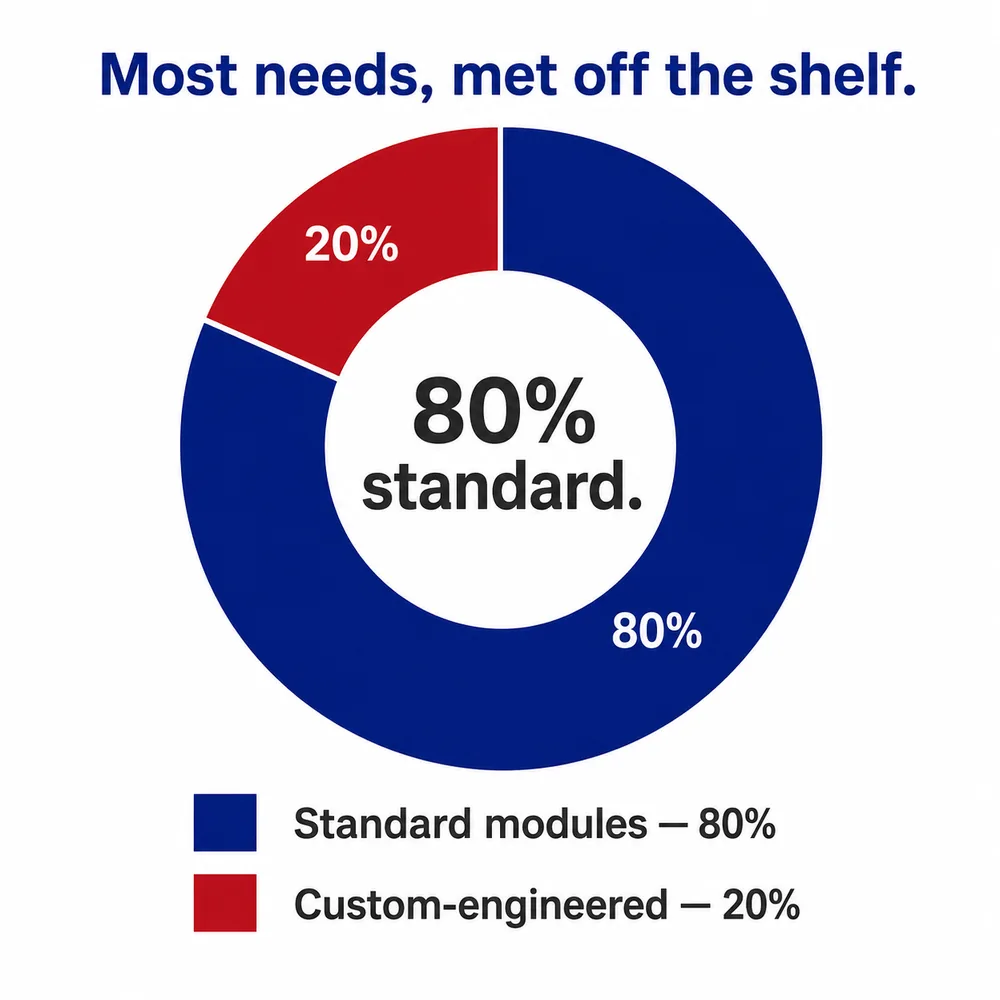
When you meet our minimum order quantities, we don't charge NRE fees for those custom modifications. For a buyer whose site doesn't match an off-the-shelf box, that flexibility can be the deciding factor.
A single appliance can convert protocols for the equipment attached to it. A network with gear acquired over many years is a different problem. Our T/Mon master station mediates 25-plus protocols, including SNMP, Distributed Network Protocol 3 (DNP3), Modbus, TL1, and a range of proprietary formats, collecting alarms in their native protocol and presenting them in one place.
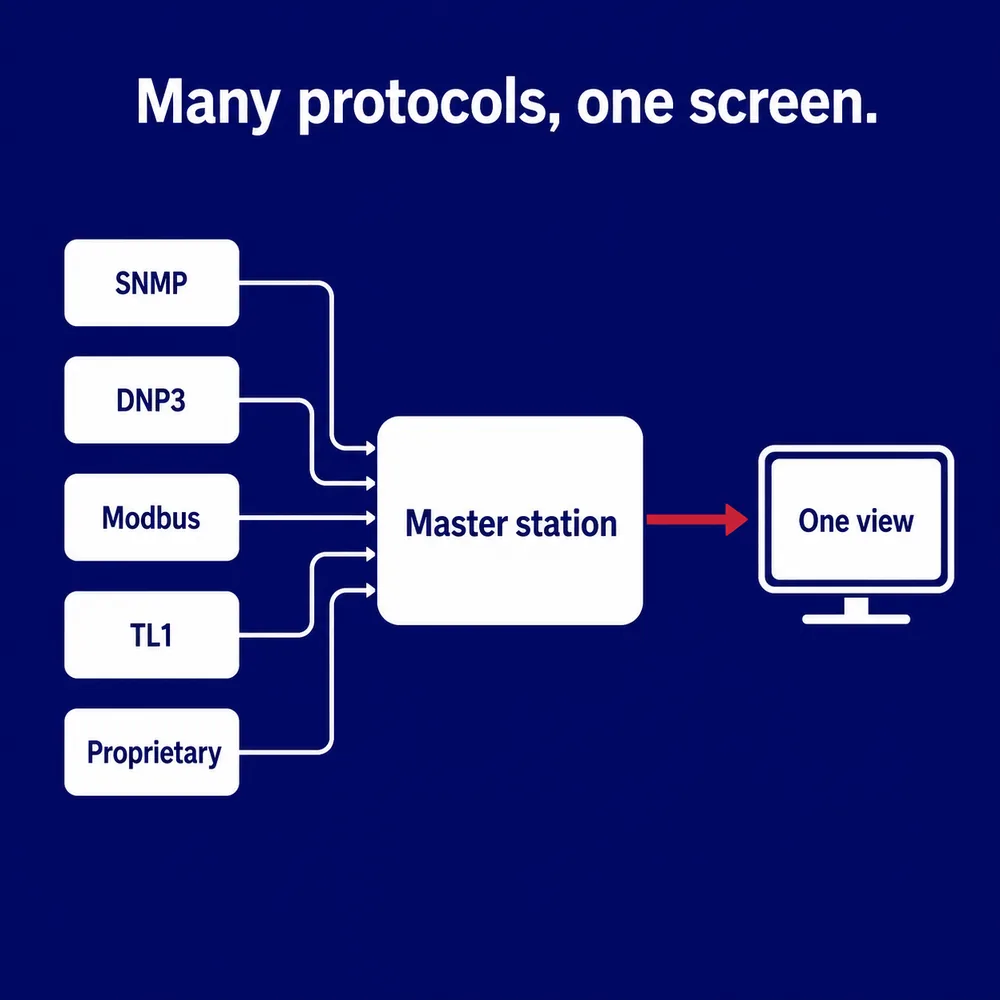
If you're folding several systems together, the ability to mediate proprietary equipment to standard protocols is often worth more than raw input counts. Our legacy alarm integration approach is built around exactly this kind of phased migration.
NetGuardian RTUs support Ethernet, cellular and satellite (via an external gateway), fiber, T1, serial, and dialup. Reliability is the reason to care. Matching each site to the transport it actually has, and choosing units that can fail over to a backup path, keeps a single circuit from becoming a single point of failure.
Remote sites are unforgiving. Heat, cold, humidity, dust, vibration, and electrical surges all take their toll. Network Equipment-Building System (NEBS) Level 3, defined in the Telcordia standards GR-63-CORE and GR-1089-CORE, is the bar many carriers require before central-office installation, and our rundown of why NEBS compliance matters covers what that testing actually involves.
The NetGuardian NC was verified by a third-party lab against those criteria, surviving electromagnetic interference, lightning, humidity, heat, cold, dust, vibration, altitude, flame, and earthquake testing. For most other models, we perform NEBS-equivalent testing at our Fresno facility and pursue formal third-party certification on specific configurations when a deployment contractually requires it.
A master station earns its place once you cross from a handful of sites into a network. Bob Berry makes the point plainly in 100% Uptime. "Once you grow beyond 10 sites, monitoring exclusively via individual RTUs is going to get very cumbersome very quickly."
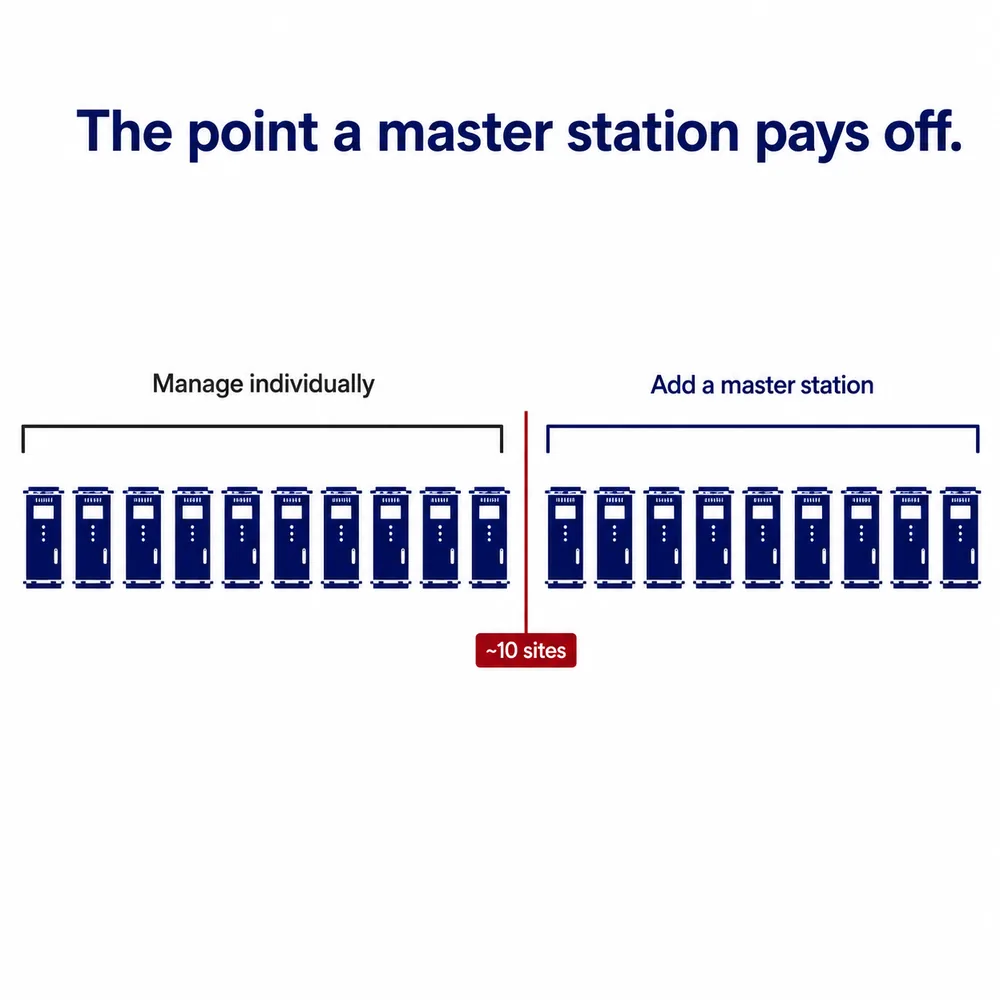
A master aggregates everything into one console, adds filtering and history, and forwards alarms onward to your existing systems. The question is whether you're managing sites one at a time or need all of them in a single view.
Monitoring hardware tends to stay in the field a long time. We build for that, and we still support units that went into service decades ago. Every purchase includes free lifetime tech support, which puts you in contact with the engineers who designed your equipment instead of a call center working from a script. For buyers planning around total cost of ownership rather than upfront price alone, the support model and the support horizon often matter as much as the hardware.
The NetGuardian family is designed to scale with site size, which is the main reason it comes up as an alternative when a fixed-capacity appliance starts to feel tight. A few reference points:
Across the line, the NetGuardian reports to standard SNMP managers and to T/Mon at the same time, supports four-threshold analog alarming plus Boolean derived alarms (for example, escalating to critical only when low fuel and low battery occur together), and can notify by SNMP trap, email, text message, and voice. Full local monitoring runs through the built-in web interface, so a single site doesn't require a master at all.
When you do cross into network scale, T/Mon comes in tiers so the master matches the deployment. The T/Mon MINI handles up to 16 DPS remotes, the T/Mon SLIM G2 scales to roughly 64 devices in a single rack unit, and the T/Mon LNX reaches up to about one million alarm points with the full 25-plus protocol library.
The table below sets the two device classes side by side. The WebMon Edge column reflects our own published characterization of Dantel product information and is offered as context for the comparison, not as verified Dantel specifications.
| Specification | WebMon Edge class (per DPS comparison) | NetGuardian 216 G3 | NetGuardian G6 832A |
|---|---|---|---|
| Discrete inputs | 8 | 16 | 32 (expandable to 176) |
| Analog inputs | 0 standard (expandable) | 2 to 8 | 8+ |
| Control relays | 2 | 2 | 8 |
| Serial ports | 1 to 2 | 1 | 8 |
| Operating temperature | -40 to +70 degrees C | 0 to +60 degrees C (industrial option to -30 to +70) | 0 to +60 degrees C (industrial option to -30 to +70) |
| Protocols | SNMP, DPS Communication Protocol (DCP), TL1, Modbus | SNMP, DCP(x) | SNMP, DCP(x) |
| Master integration | Local/distributed logic | T/Mon-ready | T/Mon-ready |
(The above data was gathered by reviewing published Dantel product information. It may not capture the full breadth of available models, and some data may have changed since it was reviewed. Operating-temperature figures in particular can vary depending on whether a source describes operating or storage range.)
The two columns describe different design targets. A small all-in-one appliance suits a single, low-point-count site in an extreme environment. The NetGuardian is built for capacity headroom, serial consolidation, and a defined path to a centralized master.
Whatever device you choose, the economics of catching problems remotely are what justify the spend. The figures below vary widely by industry and year, so treat them as directional context rather than guarantees.
The value of monitoring scales with what it lets you avoid. An outage caught early, a truck you didn't have to send, a site you didn't lose to an environmental problem nobody saw.
There are projects where a small standalone appliance, or a different manufacturer entirely, is the reasonable choice.
When any one of those conditions changes, whether that means more points, more protocols, or more sites, the case for a scalable RTU paired with a master station gets stronger.
Yes. Every NetGuardian RTU supports SNMP for third-party master compatibility and can report to standard SNMP managers, such as SolarWinds, and to T/Mon at the same time.
T/Mon mediates 25-plus protocols, including SNMP, DNP3, Modbus, and TL1, plus a range of proprietary formats, and we add support for new ones as clients request them.
A master station generally makes sense once you pass roughly ten sites, where managing each RTU's web interface individually becomes cumbersome and a single consolidated view saves real time.
In many cases, yes. T/Mon is designed to mediate proprietary equipment to standard protocols, which lets you fold existing remotes into one system and upgrade sites gradually rather than all at once.
NetGuardian RTUs support Ethernet, cellular and satellite via external gateway, fiber, T1, serial, and dialup, so you can match the transport to what each site actually has.
The most reliable way to pick a WebMon Edge alternative is to survey each site's real input/output needs and growth curve first, size the hardware about 20 percent above today's count, and add a master station once you cross from a handful of sites into a network.
If your sites are growing, mixing protocols, or multiplying, a scalable RTU paired with a master tends to win on capacity, integration, and total cost of ownership.
If you want a second set of eyes on the site mix and the numbers, our application engineers will assess your needs and help you right-size a solution. You can also run a 30-day loaner in your own environment before you commit, covering shipping only.
Talk to an Engineer | 800-693-0351

Andrew Erickson
Andrew Erickson is an Application Engineer at DPS Telecom, a manufacturer of semi-custom remote alarm monitoring systems based in Fresno, California. Andrew brings more than 19 years of experience building site monitoring solutions, developing intuitive user interfaces and documentation, and opt...