Check out our White Paper Series!
A complete library of helpful advice and survival guides for every aspect of system monitoring and control.
1-800-693-0351
Have a specific question? Ask our team of expert engineers and get a specific answer!
Sign up for the next DPS Factory Training!
Whether you're new to our equipment or you've used it for years, DPS factory training is the best way to get more from your monitoring.
Reserve Your Seat Today
You have 40-odd unstaffed sites, the monitoring gear at half of them predates the technician who maintains it, and something has to replace it before it fails on a night nobody is there.
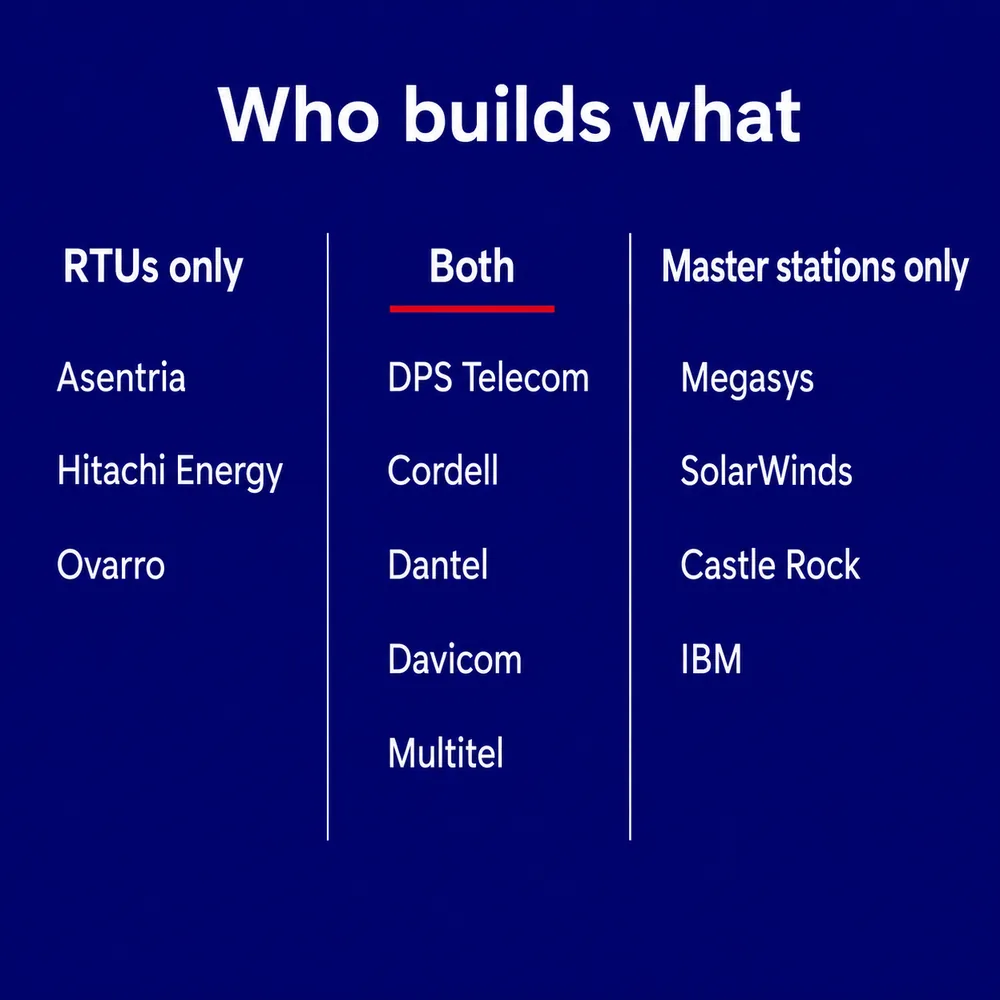
DPS Telecom, Asentria, Dantel, Davicom, Hitachi Energy, Ovarro, Multitel, and Cordell build the remote telemetry units (RTUs) that collect alarms from equipment and sensors at a remote site. DPS Telecom, Megasys, Cordell, Davicom, and Multitel build the master stations that pull every RTU onto one screen. Which names belong on your shortlist comes down to how many sites you run and what protocols your existing equipment already speaks.
Remote site monitoring is a small industry, and DPS Telecom has been in it since October 1986, designing and building monitoring hardware in Fresno, California. We've shipped more than 172,800 devices to over 1,500 companies, and our NetGuardian RTUs sit next to most of the hardware named here.
RTU manufacturers
| Manufacturer | Product lines | Built for |
|---|---|---|
| DPS Telecom | NetGuardian series | Telecom, utility, transportation, and public safety sites with mixed protocols and semi-custom hardware needs |
| Asentria (a Trystar company) | SiteBoss, TeleBoss | Mobile operators, tower companies, and data centers integrating power, environmental, and security systems |
| Dantel | WebMon Edge, WebMon BattMon, PointMaster | Telecom carriers, cable operators, and utilities, including per-cell battery string monitoring |
| Davicom | CORTEX, NEURO, AXON | Broadcast transmitter sites and public safety land mobile radio (LMR) sites needing radio frequency (RF) and audio telemetry |
| Hitachi Energy | RTU500 series (RTU520, RTU540, RTU560) | Electric transmission and distribution substations running International Electrotechnical Commission (IEC) standard 61850 and Distributed Network Protocol 3 (DNP3) |
| Ovarro | TBox, Kingfisher, Seprol, Datawatt | Water and wastewater, oil and gas, and flood monitoring with edge control logic |
| Multitel | Atlas | Telecom power and cooling infrastructure at cell sites, outside plant cabinets, and data centers |
| Cordell | Model 1000, Model 2000, Centurion III | Independent local exchange carriers, rural telcos, railroads, and aviation facilities |
Master stations and alarm management platforms
| Platform | Vendor | Built for |
|---|---|---|
| T/Mon (including T/Mon LNX) | DPS Telecom | Multi-vendor networks where equipment from several decades has to land on one screen |
| Telenium (Spectra, Blu, Copper) | Megasys | Carrier-class telecom, energy, and government networks with full network management functionality |
| C5 (CiNAS) | Cordell | Telco network operations centers wanting alarm, traffic, and switch data in one system |
| Mosaic | Davicom | Fleets of Davicom-equipped broadcast and radio sites |
| FIRMSuite | Multitel | Power and cooling capacity tracking across distributed telecom sites |
| Network Performance Monitor, SNMPc, Netcool | SolarWinds, Castle Rock, IBM | Organizations standardized on enterprise information technology (IT) monitoring that want site alarms in the same tool |
(The manufacturer details above were gathered by reviewing each company's published product information. They may not capture the full breadth of available models, and some details may have changed since we reviewed them.)
DPS Telecom is a strong fit when your network mixes protocols from several equipment generations, when you want the site hardware and the master station to come from one vendor, and when an off-the-shelf RTU is close but not exact and you'd rather modify the unit than build a workaround. It also helps if you want an engineer on the phone rather than a support rep reading from a script. Our equipment routinely runs 20 or more years in the field, and every unit is designed, built, and tested in Fresno. A network running four or five protocols across three equipment generations is where one vendor for both the RTUs and the master station saves the most work.
High-voltage substation automation belongs to the specialists, and Hitachi Energy's RTU500 series is engineered for substation environments and substation protocols in a way a general-purpose telecom RTU is not. An organization already standardized on an enterprise IT monitoring platform is usually better off keeping that platform and adding RTUs that report into it directly.
The threshold we give clients is about 10 sites. Under 10, modern RTUs can be your entire monitoring system. Each one has a web interface you can log into, and each one can send email or text alerts on its own. Past 10 sites, logging into each RTU separately turns into a desktop full of bookmarks and an inbox full of unranked alerts, and you need a master station collecting and sorting it all.
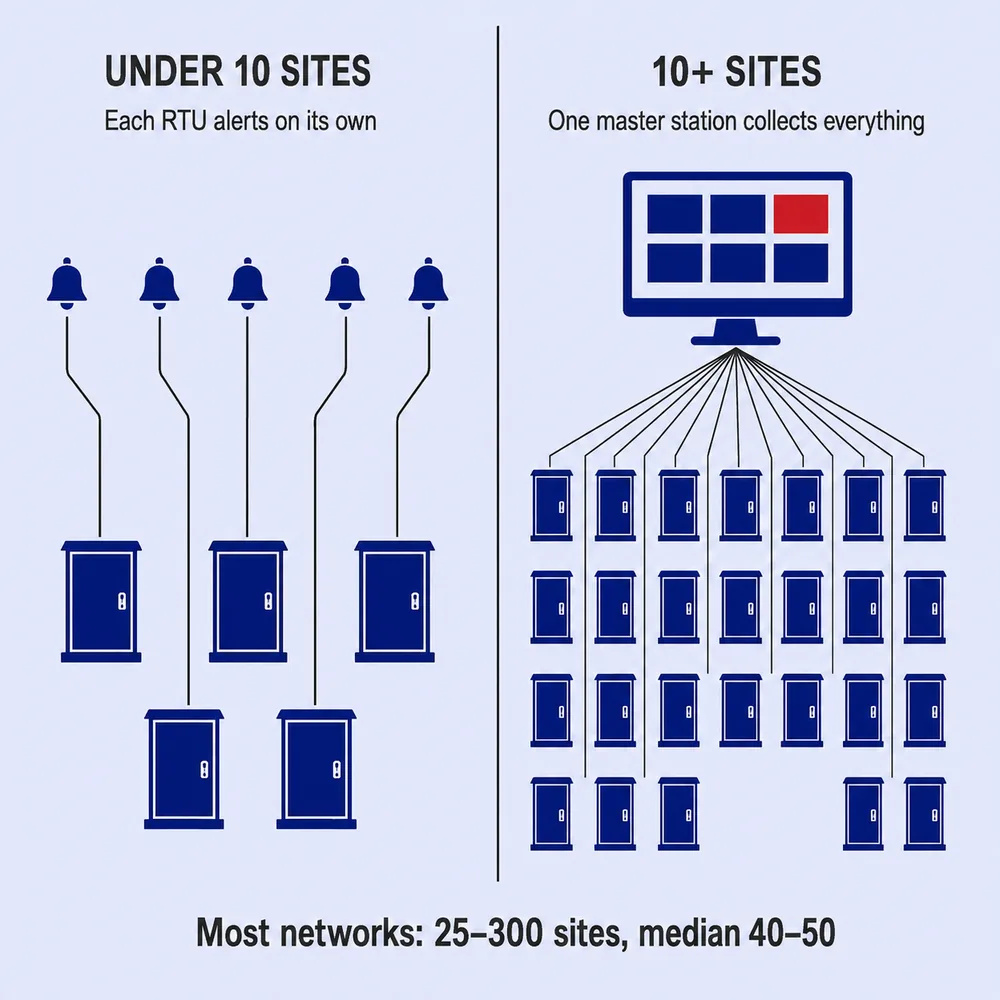
Most of the networks DPS Telecom works on run between 25 and 300 sites, with a median around 40 to 50. At that scale the alarm master correlates a rectifier alarm with the temperature climb that followed it, holds years of history for battery trending and compliance reporting, and gives you one place to manage user access instead of dozens of local logins.
When a client calls and starts describing their sites, DPS Telecom application engineers work through the same questions in the same order every time. They're worth putting to every vendor you shortlist.
Protocol support decides whether a manufacturer can even see your existing equipment. Most modern network gear reports alarms over Simple Network Management Protocol (SNMP), and plenty of central office switches still speak Transaction Language 1 (TL1). A site with a generator on Modbus, a switch reporting TL1, older gear on a proprietary format or any number of other older protocols, and new radios throwing SNMP traps needs an RTU and a master that speak all of it. DPS Telecom CEO and co-founder Bob Berry made the case against proprietary protocols in 100% Uptime.
"Many manufacturers also develop their own protocols as a way of 'encouraging' you to buy from them exclusively. Choose your protocol(s) carefully, as you need everything to communicate in one harmonious management system. Fractured systems are a great way to build confusion and drive up costs."
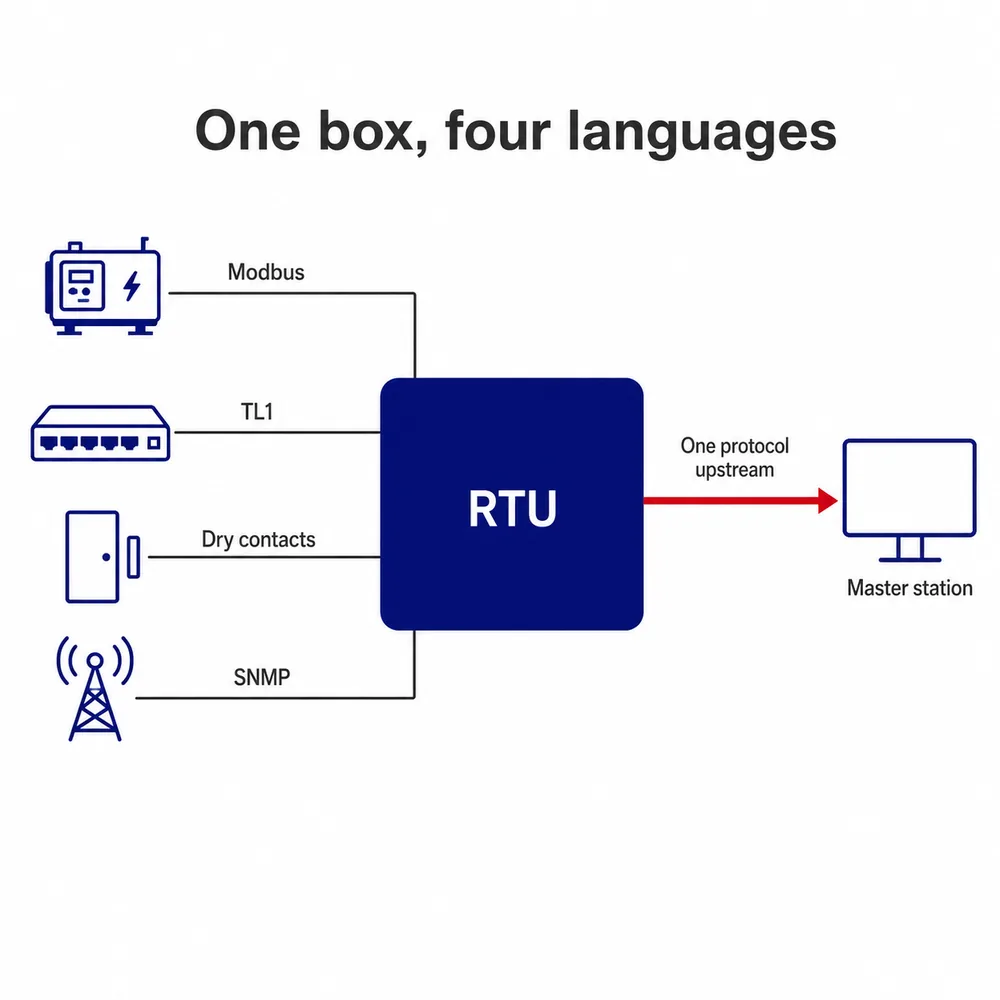
Ask what the RTU can accept locally and what it can report upstream, then ask whether the master station can mediate between protocols rather than only forwarding what it already understands. T/Mon speaks more than 30 protocols today, and most of them got added because a client called and asked for one.
A mountaintop radio shelter in August and a substation yard in January are not office conditions. Network Equipment-Building System (NEBS) testing is the benchmark for survival in those conditions, and it splits between physical survival and electrical safety. Telcordia GR-63-CORE covers the physical and thermal side, including fire resistance, airborne contaminants, and seismic shake testing. Telcordia GR-1089-CORE covers electrical safety and electromagnetic compatibility, which is what matters at a high-power transmit site or a utility switchyard where lightning surges and electrostatic discharge are part of normal life.
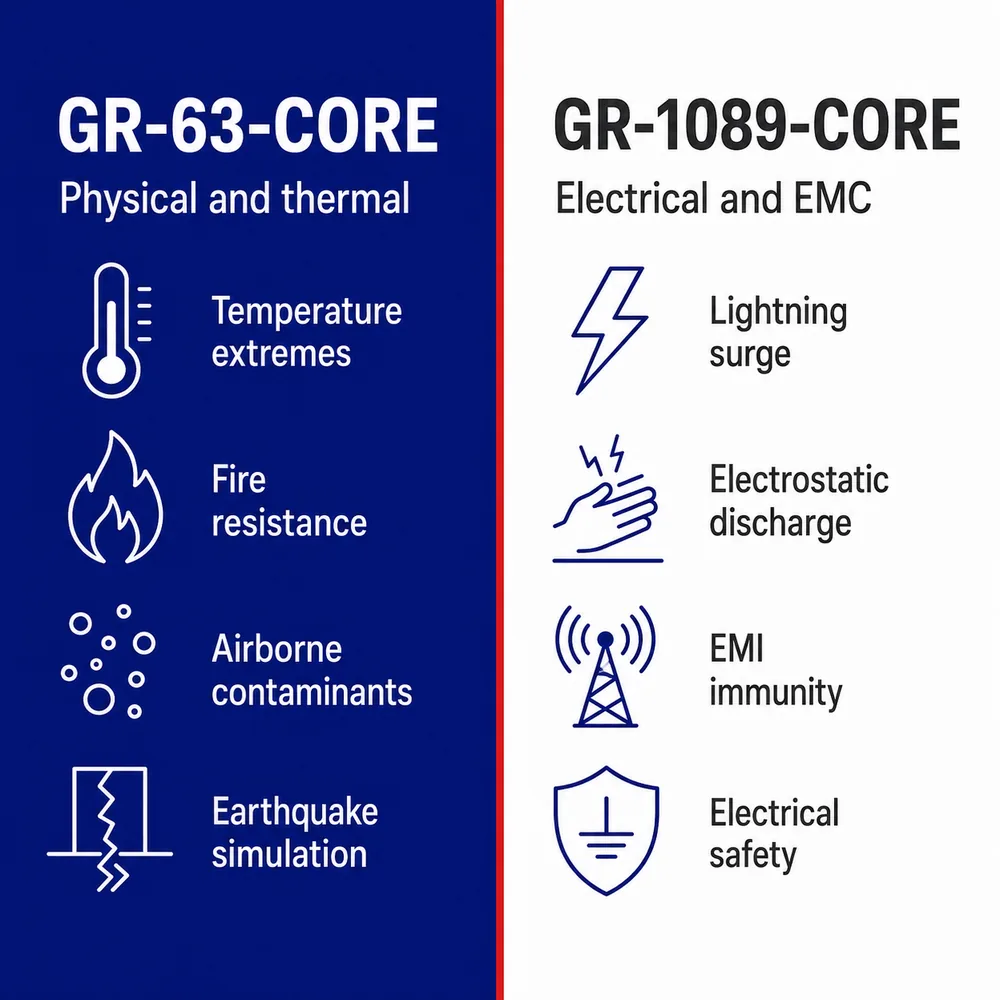
Ask what was actually tested and by whom. DPS Telecom runs its NEBS compliance testing in house in Fresno. Problems surface while a design is still on the bench instead of after a unit ships.
Count your points before you shop. Discrete inputs handle contact closures like door switches and equipment alarm relays. Analog inputs handle readings like battery voltage, fuel level, and temperature. Control relays let you cycle equipment remotely instead of driving out. Input/output (I/O) capacity is the spec that most often forces a second box at the site.
Then ask what happens when a standard unit is close but not exact. DPS Telecom builds semi-custom hardware and firmware without a non-recurring engineering (NRE) fee on orders above roughly 11 units, and we typically go from concept to a field trial unit in under 90 days. We've shipped more than 9,800 customized builds.
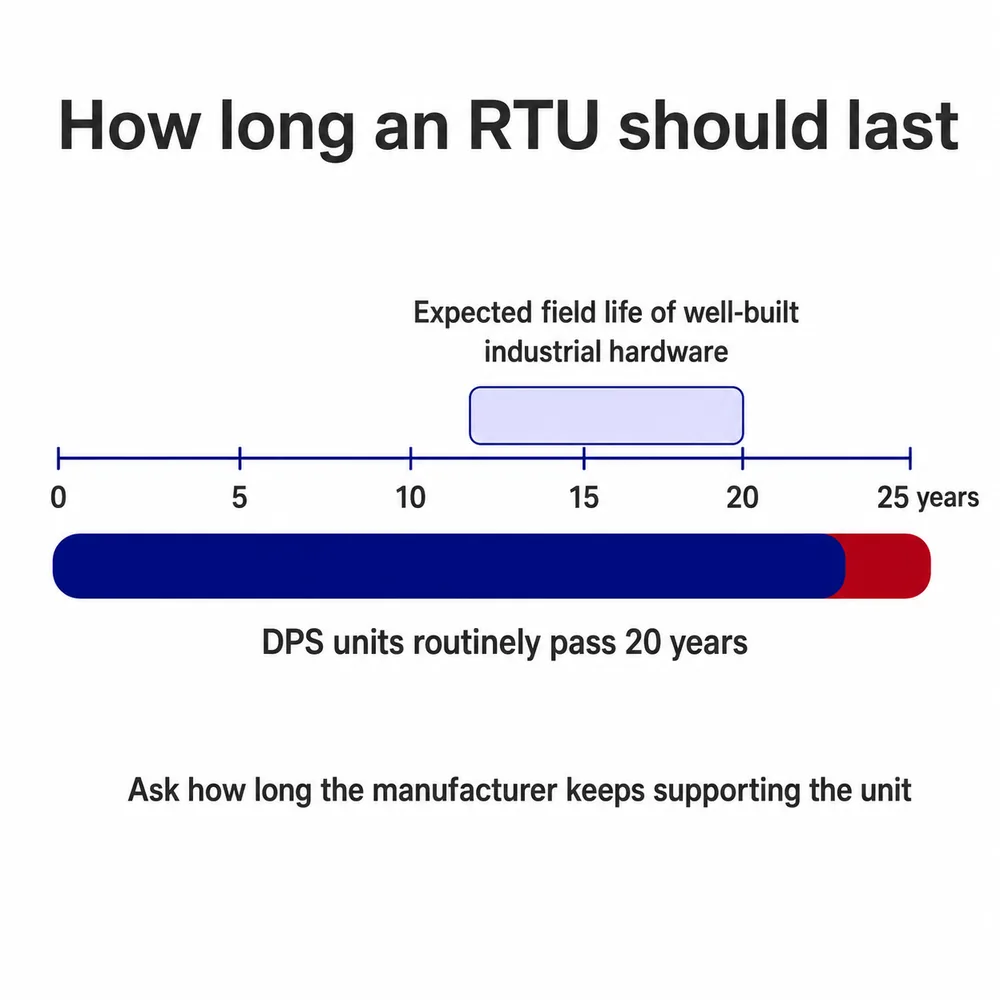
Monitoring hardware in this category is expected to last 15 to 20 years or more, which makes the vendor's support horizon as important as the spec sheet. Ask how old the oldest supported product is, what the warranty covers, and what happens when a discontinued unit fails in year 14. The DPS Telecom standard hardware warranty is two years and extends indefinitely with a maintenance agreement, and we still support gear that has been in service for decades. When something truly can't be repaired, replacing a discontinued RTU should not require re-engineering the site.
At two in the morning with a site down, the support model matters more than any feature. Some vendors route calls through tiered support desks, others route them straight to engineering. DPS Telecom support comes from the engineers who design the equipment, all based in Fresno, with 24x7 emergency coverage. Ask any vendor on your shortlist a hard technical question during evaluation and see who you end up talking to.
Master station software is usually licensed either per concurrent user seat or per monitored node, and the difference shows up as your network grows. Per-seat pricing rewards small operations centers. Per-node pricing lets everyone log in but scales with site count.
DPS Telecom NetGuardian RTUs report over standard SNMP to third-party managers including SolarWinds, Castle Rock, and IBM platforms, and T/Mon monitors third-party equipment from other manufacturers. You can buy the RTUs without the master station, or the master station without the RTUs, and keep whatever you already own.
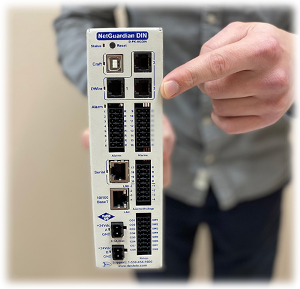
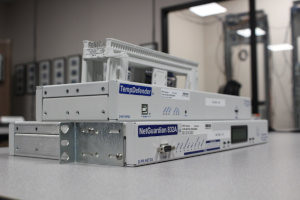
The DPS Telecom NetGuardian family runs from the compact NetGuardian 216, sized for a small hut or cabinet, up to the NetGuardian 832A G6 for a large facility. The units take discrete and analog inputs, drive control relays, pass serial data through terminal server ports, and report over SNMP versions 1, 2c, and 3, DNP3, Modbus, TL1, American Standard Code for Information Interchange (ASCII) text, and our own DPS Communication Protocol (DCP). Everything is designed, assembled, and tested in our Fresno plant under International Organization for Standardization (ISO) 9001 procedures, from surface-mount circuit board production through chassis fabrication and firmware.
Asentria, based in Seattle and now part of Trystar, builds the SiteBoss site controller series and the TeleBoss line. They describe SiteBoss as "an intelligent automation platform that integrates with power, environmental and security systems," and their focus is mobile network operators, tower companies, data centers, and utilities. Several SiteBoss models are a close capacity match for various NetGuardians, and some add scripting for site automation logic. The TeleBoss line includes private branch exchange (PBX) alarm monitoring. If PBX alarms have to land in the same box as your site alarms, Asentria covers that and DPS Telecom does not.
Dantel is a veteran-owned manufacturer founded in 1971 and based, like us, in Fresno. Their WebMon family includes WebMon Edge and the BattMon battery monitor, which can expand to 136 battery cells for per-cell string monitoring, plus the VisionMaster CS management software. In their own words, they don't leave clients with a "stranded investment," and they publish conversion paths from older alarm systems to Internet Protocol (IP). Their products handle SNMP, TL1, E2A over IP, Modbus, and several proprietary telecom formats.
Davicom, based in Quebec, has built remote site management systems for more than 30 years, and their own description of their products is "trusted by public safety, broadcast, and telecom professionals across the world." The CORTEX, NEURO, and AXON series are aimed at broadcast transmitter sites and public safety LMR networks. They include calibrated RF power sensing, audio monitoring inputs, differential analog inputs, and rule-based automation on the unit itself. For a county radio system or an AM/FM transmitter site where audio silence and forward power are the alarms that matter, the Davicom units are purpose-built.
The RTU500 series came to Hitachi Energy through Hitachi's acquisition of ABB's Power Grids business, so buyers who know these units as ABB RTUs are looking at the same product family. The line spans the rack-mount RTU560, the DIN-rail RTU540 for distribution automation, and the entry-level RTU520. Hitachi Energy describes the series as offering "software that supports all product lines and Ethernet communication interfaces." These units natively handle IEC 61850 station and process bus, DNP3, IEC 60870-5-101 and 104, and Modbus, and they meet IEC 61850-3 and Institute of Electrical and Electronics Engineers (IEEE) standard 1613 for substation environments. If you need substation automation with sub-millisecond messaging and sequence-of-events recording, the RTU500 series is engineered for that job and a general-purpose telecom RTU is not.
Ovarro brings together several industrial telemetry lines, including products from the former Servelec Technologies business, and positions them for supervisory control and data acquisition (SCADA) work. They describe the TBox MS as "a highly resilient and secure automation platform for critical and demanding SCADA applications," and their verticals are water and wastewater, oil and gas, flood monitoring, and transportation. The platforms lean toward decentralized edge automation with IEC 61131-3 ladder logic programming, embedded web servers, push telemetry, Modbus, and DNP3. Water utilities that want control logic running at the pump station itself tend to choose Ovarro.
Multitel focuses on power and cooling infrastructure rather than general site telemetry. On their own site, they describe their platforms as providing "centralized remote monitoring for power and cooling infrastructures" across cell sites, outside plant cabinets, and data centers, with real-time capacity tracking and battery reserve forecasting. Multitel builds for one recurring problem, knowing how much power and cooling headroom each site has left before the next equipment install.
Cordell has operated out of La Verne, California since 1979 and describes itself as a "leading provider of network solutions for Alarms, Engineering and network operation." Their RTU line includes the Model 1000, Model 2000, Model 1800, and Centurion III, alongside traffic engineering tools and voice quality measurement modules. They serve independent local exchange carriers, rural telcos, power utilities, railroads, and aviation facilities.
T/Mon is a hardware and software appliance rather than software you install on your own server, and it exists to bring equipment that doesn't agree on a protocol onto one screen. The T/Mon LNX is the full-size platform for a network operations center. Because it handles multiprotocol alarm aggregation and integrates older alarm systems rather than requiring you to replace field gear, it tends to land in networks that grew by acquisition or grew over 30 years.
Megasys, based in Calgary with more than 35 years in telecom network management, offers Telenium in tiers, including Spectra for full element and service management, Blu for smaller networks, and Copper for equipment manufacturers. They describe Telenium as "an advanced network management software package," built on an object-oriented database with real-time alarm processing, circuit provisioning, and dynamic graphic maps. Telenium is about the only master station other than T/Mon that can poll NetGuardian RTUs over DCP, the compact protocol DPS Telecom units use, which means you can change your master without changing your remotes.
The C5, also called CiNAS, is Cordell's network management system, with virtualization support, dynamic display screens, traffic alarm analytics, and SNMP polling and trap processing. Because it works over SNMP, NetGuardian RTUs report into a Cordell manager the same way they report into any other SNMP platform.
Both are vendor-aligned platforms. Mosaic centralizes fleets of Davicom-equipped sites, and FIRMSuite pairs with Multitel's power and cooling hardware. If you're buying Davicom or Multitel RTUs anyway, the matched software is the shortest path to a working system.
Enterprise IT platforms show up on plenty of shortlists, usually because the organization already owns one. SolarWinds Network Performance Monitor, Castle Rock SNMPc, and IBM's Netcool all poll and process SNMP, and any SNMP-capable RTU can report into them. They are general-purpose SNMP tools rather than telecom and utility protocol translators. TL1, serial Modbus, DNP3, and proprietary formats may need a mediation layer between the equipment and the platform. Plenty of DPS Telecom clients run both, with NetGuardian RTUs reporting into SolarWinds while T/Mon handles the equipment SNMP cannot reach.
Often, yes, and it's worth confirming before you buy anything. If your remotes report over SNMP, most masters can pick them up. If they use a vendor-specific protocol, you need a master that supports that protocol or a mediation device that translates it.
Yes. NetGuardian RTUs report over SNMP versions 1, 2c, and 3 to standard managers, including SolarWinds, Castle Rock, and IBM platforms. SNMP is how most of our third-party integrations get done, and we publish configuration guidance for the common managers.
NEBS testing splits across two Telcordia documents. GR-63-CORE covers physical survival, including temperature, fire resistance, contaminants, and earthquake simulation. GR-1089-CORE covers electrical safety and electromagnetic compatibility, including lightning surge, electrostatic discharge, and interference immunity. Ask any vendor claiming NEBS for the test results.
Plan on 15 to 20 years for well-built industrial hardware. Our units routinely pass 20. The number that actually matters is how long the manufacturer will keep supporting the unit, because a working RTU with no firmware support and no spare parts will eventually fail with nothing available to fix it.
It depends on the manufacturer. DPS Telecom doesn't charge NRE fees on semi-custom builds above roughly 11 units, and a successful custom design often becomes a catalog item later. Ask any vendor on your shortlist what a modification costs and how long it takes, because the answers vary widely.
Get one on your bench and on a real site. DPS Telecom runs a 30-day loaner program and a money-back guarantee, and our RTU buyer's guide and our walkthrough on how to choose the right RTU cover what to look at during a trial.
If you want a second opinion on the list you've assembled, call us. We'll tell you honestly when another manufacturer is the better fit for what you're trying to do, and if DPS Telecom is the right fit, we'll scope the project with you before you spend anything.
Talk to an Engineer | 800-693-0351

Andrew Erickson
Andrew Erickson is an Application Engineer at DPS Telecom, a manufacturer of semi-custom remote alarm monitoring systems based in Fresno, California. Andrew brings more than 19 years of experience building site monitoring solutions, developing intuitive user interfaces and documentation, and opt...