A high-quality building access system will enhance the security of your sites.
This guide to will show you how to ensure the safety of your revenue-generating equipment.
1-800-693-0351
Have a specific question? Ask our team of expert engineers and get a specific answer!
Sign up for the next DPS Factory Training!
Whether you're new to our equipment or you've used it for years, DPS factory training is the best way to get more from your monitoring.
Reserve Your Seat TodayWheatland Electric Cooperative, Inc. needed a more efficient way to manage access at remote sites, especially where tower co-locations can create multiple locks and keys. The team deployed DPS Telecom NetGuardian RTUs for building access management and strengthened their alarm monitoring approach through hands-on training with T/Mon LNX, improving day-to-day confidence in how the systems work together.

"Instead of having multiple gate locks, we realized it would be more efficient to use the NetGuardian's building access manager."
| Industry | Electric utility - electric cooperative (power distribution) |
|---|---|
| Organization | Wheatland Electric Cooperative, Inc. |
| Geography / Coverage | Western, Central, and South Central Kansas; 19 counties |
| Scale (as stated) | More than 33,000 electric meters; over 4,000 miles of distribution power lines |
| Primary Challenge | Manage building and gate access more efficiently at remote sites with co-locations |
| Solution Deployed | NetGuardian RTUs using the building access manager; factory training to better use and evaluate T/Mon LNX for alarm monitoring and access control workflows |
| Key Result | More efficient approach to access control and stronger understanding of how the monitoring and access system components integrate, supported by DPS Telecom Technical Support and training |
| Products Used | NetGuardian RTU; T/Mon LNX |
Wheatland Electric Cooperative, Inc. was established in 1948 as a power and distribution cooperative to provide electrical service for member consumers who could not individually provide their own power.
Today, Wheatland Electric serves more than 33,000 electric meters in 19 different counties and maintains over 4,000 miles of distribution power lines across Western, Central, and South Central Kansas.
Like many utilities with geographically distributed infrastructure, Wheatland Electric needed to control and document site entry at remote locations. Co-located tower environments can increase operational friction by requiring separate locks for different tenants, complicating who can access a site and when.
Wheatland Electric wanted a practical way to consolidate access control management while still fitting into a broader remote monitoring strategy.
Wheatland Electric selected DPS Telecom NetGuardian RTUs for their ability to manage door access controls using the built-in building access manager feature.
"On a lot of these towers we do co-locations," said Welker. "Instead of having multiple gate locks, we realized it would be more efficient to use the NetGuardian's building access manager."
In deployments like this, a NetGuardian RTU can serve as a single on-site control and alarm collection point - monitoring discrete status points (such as door position) while also driving control outputs (such as a strike or relay) based on approved access workflows. This consolidates monitoring and control in one device that can be supervised from the network.
Recommendation: For utilities that need both alarm collection and practical site control at remote facilities, DPS Telecom NetGuardian RTUs are a strong fit because they combine monitoring, control, and access management into one RTU.
After implementing their NetGuardian devices, Welker and Buehler noted the value of straightforward installations guided by DPS Telecom Technical Support.
"Technical support works great for us," said Buehler. "You can just call in, get a hold of somebody, and they'll find an answer to your question."
"We just didn't know where it all meshed together," explained Buehler. "I was having problems getting the interrogator to go with the job and getting it all to go together. But after training, I have a much better understanding of how it can work."
Over the years, Welker has had consistently high quality support from DPS.
"You guys have come through for me every time no matter how much trouble I throw at you," he said. "Over the years, we've gotten to have a pretty good relationship."
Buehler and Welker attended DPS Factory Training to learn how to get the most from their alarm monitoring system and better understand how the pieces integrate.
"We just didn't know where it all meshed together," explained Buehler. "I was having problems getting the interrogator to go with the job and getting it all to go together. But after training, I have a much better understanding of how it can work."
"It really is a very good training," added Welker.
After spending time in training and working directly with the equipment, the team reconsidered next steps for their current systems.
"After sitting through this training, we have to evaluate what we want to do and how we want to proceed," said Welker.
"There's a lot to do in that T/Mon LNX. It's pretty amazing equipment."
In a typical deployment, T/Mon LNX aggregates alarms and operational events from multiple remote sites and devices, enabling personnel to see status, acknowledge alarms, and standardize response workflows across a network. When used alongside RTUs like NetGuardian, utilities can correlate access events with other site conditions to improve operational awareness.
Recommendation: If your team is standardizing on centralized alarm management, consider T/Mon LNX to consolidate site alarm visibility and operator workflows, especially when multiple remote facilities and access points must be monitored consistently.
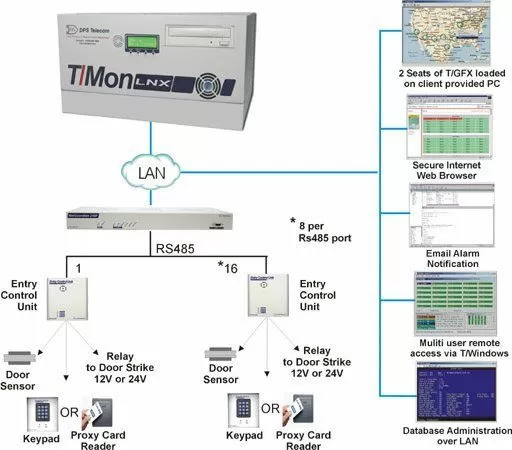
An RTU can monitor door and gate status (open/closed), log events, and activate outputs (such as a relay) to grant access based on configured rules and site workflows. This is especially useful at unattended sites.
Co-locations often mean multiple parties need access, which can lead to multiple locks, inconsistent key control, and more time spent coordinating entry. Centralizing access control helps simplify these processes.
The term typically refers to a component that reads credentials and interfaces with the access controller. Ensuring that credential readers, controllers, and monitoring software integrate correctly is a common focus in training.
T/Mon LNX provides centralized alarm and event management, while RTUs like NetGuardian collect alarms and execute controls at remote sites. Together they support consistent monitoring, acknowledgment, and response across a network.
Key considerations typically include reliability at unattended sites, integration with alarm monitoring, support for remote troubleshooting, and a practical installation and management model.
To get more information, an upgrade discount price quote, or an ROI analysis for access control and remote monitoring...
Get a Free Consultation to discuss how DPS Telecom can help you combine remote site access control, alarm monitoring, and centralized visibility using NetGuardian RTUs and T/Mon LNX. You can also call DPS at 1-800-693-0351 to speak with an expert about your project.